

38,253
tons CO₂e

Every action we take—from turning on a light bulb to driving to campus, from printing a document to powering our servers—leaves an invisible mark on the Earth. This mark is called a carbon footprint .
Simply put, your carbon footprint is the total amount of greenhouse gases (primarily carbon dioxide and methane) released into the atmosphere as a result of your daily activities. It is measured in tonnes of CO₂ equivalent (tCO₂e) and represents the environmental cost of how we live, work, learn, and move.
Think of it as the "weight" of your impact on climate change— the heavier it is, the harder we press on our planet's fragile ecosystems.
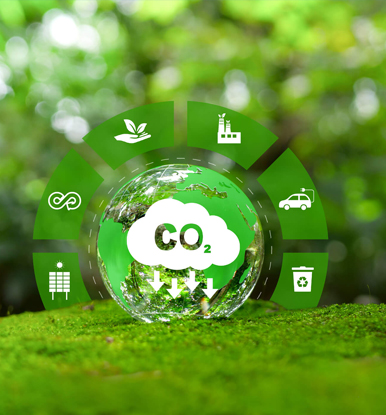
Across Abu Qir, Misr El-Gedida, Smart Village and South Valley campuses, the Arab Academy for Science, Technology and Maritime Transport measured every source of its emissions including energy, transport, water, waste and travel, following the GHG Protocol and ISO 14064-1.
Emissions were measured along a north–south line, from the Mediterranean coast at Abu Qir, through the capital at Cairo, down to South Valley near Aswan, each campus with its own energy mix, commute patterns, and fleet.
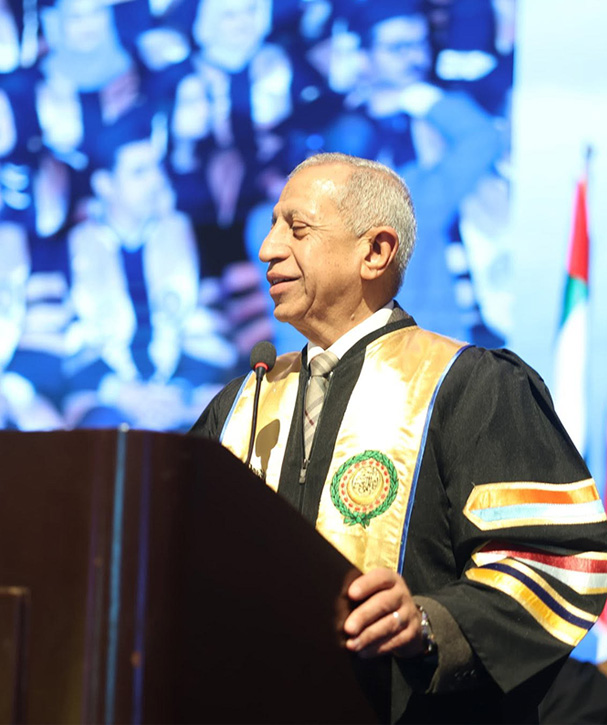
Under the direction of the President of AASTMT, a dedicated multidisciplinary committee was established under the coordination of the Research and Innovation Center to lead and coordinate the assessment of the Academy’s Carbon Footprint.
 Download Report
Climate change is not a distant threat
As the Arab region faces heightened vulnerability to climate-related risks, AASTMT recognizes its duty to act. We are not merely observers; we are agents of change.
More Than Words—Tangible Action
At AASTMT we translate vision into measurable impact by embedding environmental responsibility, social accountability, and economic efficiency into everything we do.
tons CO₂e
tons CO₂e
tons CO₂e
tons CO₂e
tons CO₂e
tons CO₂e
tons CO₂e
tons CO₂e
AASTMT's Roadmap to Climate Action
• Run campus-specific PV feasibility studies at Abu Qir, Misr El-Gedida and Smart Village.
• Prioritize integration with existing grid infrastructure.
• Compost food scraps and recycle greywater for landscaping.
• Reduce food waste and phase out single-use plastics.
• Introduce electric or hybrid shuttle buses.
Every Student and Staff Member
when it's a practical option
and report leaks as soon as you spot them
or carpool instead of driving alone
in campus cafeterias and dining halls
as they're introduced on your campus
and unplug electronics and equipment when not in use
and keep doors closed while cooling is running
or switch to digital documents where you can
or container and skip single-use plastics
join or start a sustainability initiative at your campus