


Strategic Foundations and Pillars
Introduction
AASTMT’s strategic plan is built on two interdependent layers: Cross-cutting Foundations and domain- specific Pillars. The Cross-cutting Foundations establish the conditions that make all progress possible, embedding AI literacy, governance, and digital resilience across the Academy. The Pillars then translate this groundwork into focused action in AASTMT’s core domains: education, research, training, maritime excellence, institutional leadership, and societal engagement. Each pillar is guided by a set of clear goals, ensuring that AASTMT’s transformation into an AI-native university is both comprehensive and sustainable.
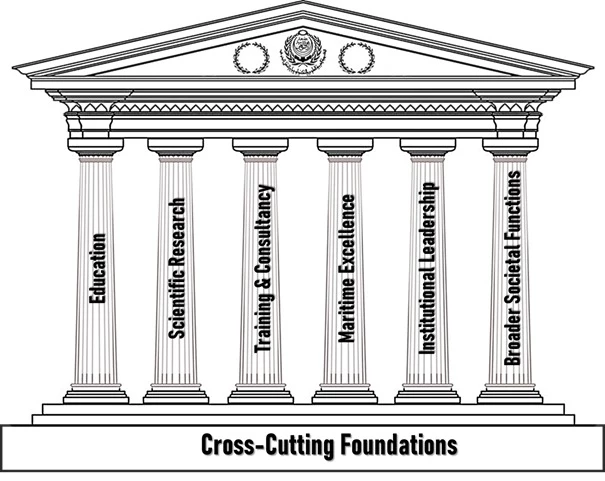
Cross-Cutting Foundations
The foundations provide the enabling environment for AI-native transformation. They ensure AASTMT remains future-ready by preparing graduates with the skills to thrive in the AI era, securing its digital and physical infrastructure, and embedding ethical guardrails that safeguard human dignity and core competencies. These measures cut across all pillars, aligning the Academy’s activities with global standards, industry needs, and societal priorities.
Specifically, the following foundational goals establish the enabling conditions that cut across all domains of AASTMT’s mission:
1.Prepare AI-enabled professionals across all specializations.
Integrate AI literacy, ethics, and domain-specific applications to ensure the responsible use of AI.
2.Embed AI as a driver of sustainable development.
Leverage AASTMT’s programs and partnerships to contribute internally and to society.
3.Build future-ready human capital aligned with industry needs.
Develop AASTMT’s faculty, staff, and leadership with future-oriented skills that respond to evolving market and sectoral needs, strengthening practical capabilities, professional adaptability, and industry engagement.
4.Upgrade digital infrastructure, cybersecurity, and data governance.
Enable secure, interoperable systems across campuses.
5.Establish governance frameworks for ethical and accountable use of AI
Align with international standards and national regulations.
6.Safeguard core human competencies in the AI era.
Maintain and strengthen critical skills, judgment, and hands-on expertise to prevent AI-induced skill loss.
7.Advance Global Leadership, Strategic Alliances, and Institutional Distinction.
Consolidate AASTMT’s international presence by expanding collaborations, dual degrees, and participation in global forums and competitions. Leverage strategic partnerships to strengthen the academy’s reputation and elevate its standing in global rankings.
8.Strengthen Integrated and Institutional governance.
Establish unified academic, financial, and administrative frameworks to ensure that AASTMT’s geographically distributed branches operate as one integrated institution. Develop standard operating procedures (SOPs) across various domains, including curricula, quality assurance, and operational procedures, to enable balanced decentralization. Develop transparent internal control mechanisms to ensure consistency and accountability.