



 Goal 17. Partnerships to achieve the Goal
17.3.15 SDG15 Report

Key Milestones in 2024-2025
Regarding SDG 15: Life on Land, the Arab Academy for Science, Technology and Maritime Transport (AASTMT) cared for and extended the green areas of its campuses, built local plants and planting basins into its construction projects, joined a community mission to protect a desert protected area in Cairo, and helped protect land from open dumping by handing over 23 sanitary landfills across Egypt. In the THE Sustainability Impact Ratings 2026, AASTMT ranked =66th of 658 institutions for SDG 15: Life on Land, with a score of 83.7.
At Abu Qir, its main campus in Alexandria, about 62,000 m² of the 213,646 m² campus (around 30%) is planted vegetation: gardens, lawns, palm groves and tree-lined avenues that give shade and shelter to birds and insects. AASTMT raises plants for these green areas in its own planting nurseries, thirteen borehole wells irrigate the gardens, and 27.8% of the campus’s water comes from non-potable sources, as reported in the AASTMT Environmental Sustainability Policy.
With its colleges and project partners, AASTMT taught school students, hotel staff, agriculture students, agri-industry staff and future planners how land, plants and soils can be used sustainably, and its students developed tools for water-saving irrigation and precision farming on desert soils.
Policies and Governance
AASTMT’s work on Life on Land rests on policies approved by the SDGs Workforce Committee and signed by the Dean of Scientific Research and Innovation. The Sustainability Office and the SDG 15 officer coordinate their implementation; the Environmental Sustainability Committee meets every quarter, and the SDGs Workforce Committee reviews progress every year.
AASTMT Environmental Sustainability Policy (Climate, Ocean and Land):
Created in January 2019 and reviewed in 2023, 2024 and October 2026 (Version 6), the policy commits AASTMT to maintain and extend the green areas and habitats of its campuses, protect threatened species, reduce the impact of alien species, and fight land degradation and desertification. Its Life on Land actions include protecting mature trees, favouring native and drought-adapted species, conserving soil through compost and drip irrigation, and planning every new building with local biodiversity in mind.
Species Policies:
The AASTMT Policy for Identifying, Monitoring and Protecting IUCN Red List and National Conservation List Species (Egypt) was created in August 2024, reviewed in 2025 (Version 2) and October 2026 (Version 3). Its priority species include the Critically Endangered Egyptian tortoise near the El Alamein campus, the Endangered steppe eagle and saker falcon on the migration flyway over Alexandria and Port Said, and the Endangered Egyptian vulture in Aswan. The AASTMT Policy for Reducing the Impact of Alien Species on Campus, approved in academic year 2024–2025 and reviewed in October 2026, sets prevention through inspected deliveries and an approved planting list, yearly plant surveys and the removal of newly found invasive species within 30 days. In the Aquaculture Research Center at Abu Qir, fish and vegetables are grown in closed hydroponic and aquaponic systems that reuse water and screen any water released, so that no live organisms reach natural waters.
AASTMT Biodiversity Action Plan and Campus Development Plan 2025–2030:
Originally prepared in 2025 and last revised on 20 November 2026, the plan turns these commitments into ten action areas, a biodiversity review for every qualifying campus project, a development plan for each campus and annual indicators.
Campus Ecosystems and Planning
Jan 2025 — New planting at the El Alamein Campus (Matrouh)
AASTMT extended the green areas of its El Alamein campus on Egypt’s North Coast: palms, shrubs and ornamental plants were planted, planting beds were improved and walkways were landscaped. The selection favoured drought-tolerant plants with irrigation suited to each species, and agricultural waste was recycled into compost for the campus lawns.
2024/2025 — The Think Tank: Planting inside and around a repurposed Building (Abu Qir)
AASTMT repurposed the hall attached to its Presidency building at Abu Qir as the Think Tank, a gathering space for students, reusing part of an existing building rather than building on new land. Planting basins were designed into the surrounding site and inside the building, along the main corridors and around the skylit staircase patio, and a shaded entrance canopy links the building to the green areas around it.
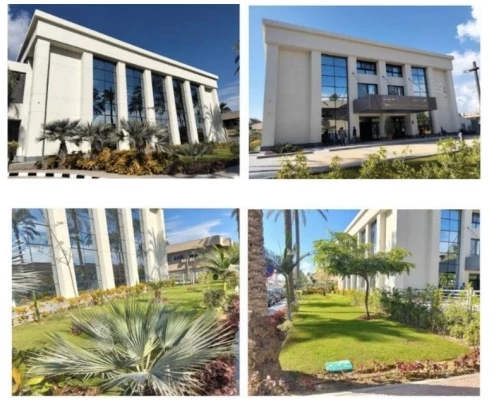
AASTMT construction standards, November 2025, pp. 9–11
Nov 2025 — Construction Standards for Every Campus
The Construction Administration issued AASTMT’s standards for constructing, operating and maintaining buildings. They set out many planting basins across each project site and the use of all vacant land around buildings for trees, shrubs, flower beds and local plants, with perforated-pipe irrigation instead of flood irrigation with drinking water, rainwater led into planting basins and the soil, and LED lighting to reduce night glare. From November 2026, the Biodiversity Action Plan adds a biodiversity review for every qualifying project, with a Biodiversity Statement before tender and no approval for a net loss of biodiversity.
AASTMT Engineering Administrations’ Approach to Constructing, Operating and Maintaining Buildings, November 2025
2022–2025 — Keeping the Abu Qir Campus Free of Net Land Degradation
The AASTMT Campus Land Sustainability Change Detection Report compares satellite images of the Abu Qir campus from 2022 and 2025. It finds that vegetation cover was stable and barren land did not expand, with new buildings placed in previously disturbed or planned development zones, and it puts net land degradation at 0%.
AASTMT Campus Land Sustainability Change Detection Report
Returning Organic Matter to Campus Soils (Abu Qir)
Under the Consumption and Recycling Policy, food waste from campus kitchens is weighed and fed to a composter unit that produces organic fertiliser for the green areas, and a closed vermicomposting unit, photographed in 2026, uses compost worms to turn organic waste into vermicompost. Facilities records for July 2025–June 2026, after the reporting period, report 35 tonnes of agricultural waste recycled at Abu Qir, listed as 20 tonnes of organic soil conditioner and 15 tonnes of compost.
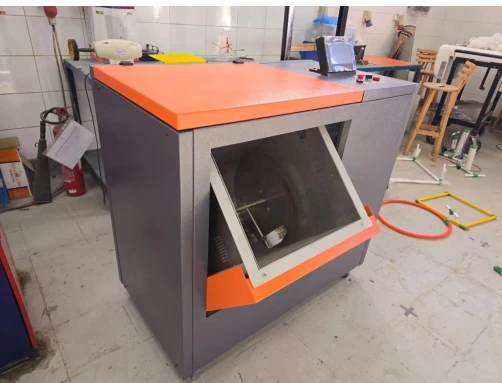
AASTMT Consumption and Recycling Policy; AASTMT Facilities statement, 2025–2026
Education and Outreach
14–19 Sep 2024 — Waste-Separation Training for Alexandria Hotels (TouMaLi)
Under the TouMaLi project, in which AASTMT is the Egyptian partner, trainers from BlackForest Solutions working with AASTMT trained housekeeping, maintenance and management staff of 23 Alexandria hotels to separate waste at source, reducing the litter that reaches the beaches and coastal land on which tourism depends.
AASTMT news, TouMaLi hotel training, September 2024
Oct 2024–Jul 2025 — Sustainable Land Management for agriculture
Students learned how land is farmed sustainably in Egypt’s drylands through visits to a medicinal plant farm in El Dabaa (October 2024), Dina Farms on reclaimed desert land (5 November 2024) and Lamar Farm in Nubaria (30 April 2025). In November 2024 AASTMT agreed with MAFI for Agricultural Produce Industries to train its staff in artificial intelligence for agriculture, and on 7 April 2025 the College of Fisheries and Aquaculture Technology trained students and staff of the Faculty of Agriculture, Minia University, in water-saving fish farming that can be combined with crop production. AASTMT students built a solar-powered robot that plants, irrigates and harvests on desert and clay soils (July 2025) and a smart water treatment and sustainable irrigation system that won the runner-up award in the WePower track of IEEE YESIST12 Prelim 2025 (May 2025).
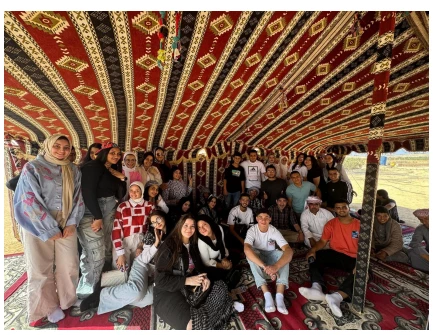
AASTMT news, October 2024–July 2025: El Dabaa farm; Dina Farms; Lamar Farm; MAFI; Minia University; solar robot; IEEE YESIST12
1–16 Feb 2025 — TOURITAGE Study Programme on Heritage and Tourism Land (El Alamein)
The Department of Architecture at the El Alamein campus hosted “Reviving Roots”, an intensive programme with open registration within the Erasmus+ TOURITAGE project coordinated by the University of Palermo. Using Leucaspis Marina and the El Alamein War Cemeteries as case studies, participants studied heritage and tourism planning, visitor management, landscape heritage and sustainable tourism products for New Alamein.
AASTMT Research, TOURITAGE
23 Jul 2025 — Medicinal Plants for Alexandria’s School Students (Abu Qir)
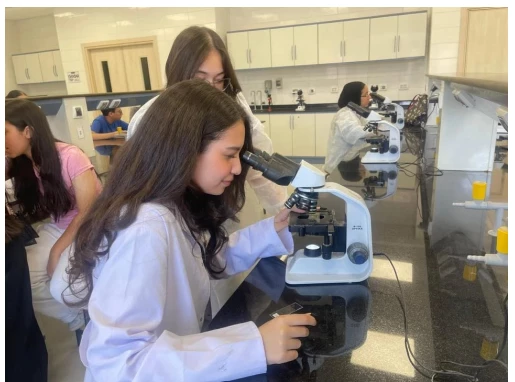
During the third edition of the College of Pharmacy Summer School for high-school students from across Alexandria, a session on medicinal plants as a source of new medicines was followed by plant identification under the microscope in the Pharmacognosy and Medicinal Plants Laboratory and a visit to the college greenhouse.
AASTMT news, Pharmacy Summer School, July 2025
Community Engagement
Nov 2024 — Climb2Change Egypt: Protecting Wadi Degla Protected Area (Cairo)
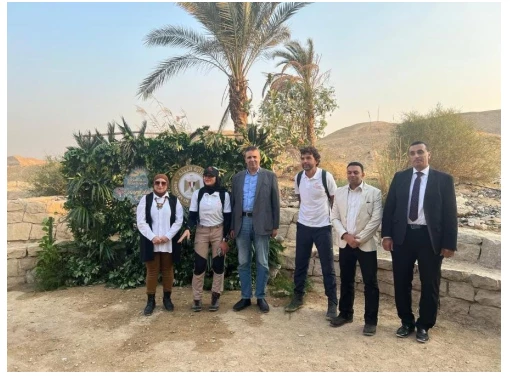
AASTMT staff and students of the College of Language and Media – Heliopolis joined Climb2Change Egypt in Wadi Degla Protected Area, a protected desert ecosystem in Cairo, with Mashreq Bank under the patronage of the Ministry of Environment, Nahdet Misr, and volunteers from schools, universities and the local community. Participants climbed the mountains of the protected area and collected, sorted and safely disposed of waste. Mashreq reported totals for the whole mission and all its participants: 2.182 tonnes of general waste and 120 tonnes of construction waste removed, 581 volunteer hours from schools, universities and community members, and 72 local entities benefiting.
AASTMT Media Center post, November 2024; Mashreq press release, 14 January 2025
10 Oct 2024 — Cleaner Beaches for Alexandria
Under the auspices of Alexandria Governorate and with the German Ministry of the Environment, AASTMT and Nahdet Misr began trial operation of two machines that sieve and clean the sand of Alexandria’s public and hotel beaches, as part of a joint project against marine litter and single-use plastics on coastal land shared by residents and visitors.
19 May 2025 — Cooperation on Egypt’s Lake Ecosystems
The AASTMT President and the Executive Director of the General Authority for the Protection and Development of Lakes and Fish Resources signed a cooperation protocol with the College of Fisheries and Aquaculture Technology covering the exchange of expertise and resources in fisheries, aquaculture and student field training.
Protecting Land from Pollution and Waste
Oct–Nov 2024 — 23 Sanitary Landfills to End Open Dumping
Between 2019 and 2023, AASTMT worked with Egypt’s ministries to build the infrastructure of the new national solid waste management system and to train the staff who run it. In October and November2024 the Academy handed over 23 sanitary landfills in 16 governorates, including new landfill cells in Damietta (23 October 2024) and Sohag (16 November 2024), replacing open dumps that contaminate soil and groundwater.
AASTMT news, October–November 2024
Hazardous Waste kept out of Soil and Water
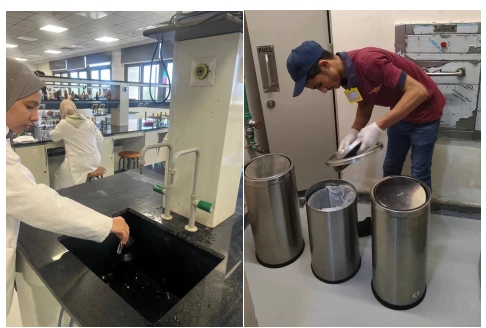
Laboratory and clinic waste is segregated at source: liquid chemical waste is collected in designated containers and neutralised where needed, biological waste is sterilised by autoclaving, and broken glass is kept separately, as the College of Pharmacy showed in its laboratories in November 2024. On the Abu Qir campus, hazardous waste is collected twice a week by Nahdet Misr, a licensed company, under staff supervision, and taken to the Alexandria Governorate hazardous waste facility at Nasreya. Since August 2024, the El Alamein campus has used colour-coded bins that keep hazardous and general waste apart.
AASTMT news, 17 November 2024; AASTMT news, El Alamein campus
Wastewater and Plastics
The AASTMT Standards and Guidelines for Discharge of Wastewater (created August 2023; Version 3 reviewed October 2026) set discharge limits under Egyptian law. At Abu Qir, separate sealed networks for sewage, rainwater and greywater carry wastewater through the campus pump station, where flow is recorded every month, to the public sewer; at El Alamein, medical and laboratory wastewater from the AASTMT Alamein Hospital is treated on site and reused for irrigation, toilet flushing and cleaning. Under the Consumption and Recycling Policy, all campus food outlets use compostable catering supplies instead of single-use plastics, plastic bottled water is no longer sold on campus, and recycling stations are provided across the campuses.
AASTMT Standards and Guidelines for Discharge of Wastewater; AASTMT Consumption and Recycling Policy
Upcoming Goals
In support of SDG 15: Life on Land, AASTMT’s Biodiversity Action Plan 2025–2030 sets out actions and milestones to strengthen biodiversity conservation across its eight campuses in Egypt through 2030. Baseline biodiversity surveys at Abu Qir and El Alamein will be completed by June 2027, and a species register for each campus will be established by December 2027. From 2027, each campus will undergo at least one biodiversity survey annually, with additional seasonal bird counts conducted twice a year at Abu Qir and El Alamein.
New planting will include at least 70% native and drought-adapted species; newly found invasive species will be removed within 30 days, and creeping oxeye and Mexican petunia, recorded in Abu Qir flower beds in the 2026 baseline, will be replaced with native plants by the end of 2028. Every qualifying project will pass a biodiversity review, with a Biodiversity Statement template issued by June 2027, and a GIS habitat map of the Abu Qir campus will be prepared by December 2027.
AASTMT also aims to raise the non-potable share of campus water from 27.8% to 35% by 2028, to document at least one collaboration a year with local communities on land ecosystems near its campuses, and to publish its first annual biodiversity report, with yearly species and alien species summaries, by December 2027.
AASTMT Biodiversity Action Plan and Campus Development Plan 2025–2030; AASTMT Environmental Sustainability Policy; AASTMT species policies
AASTMT integrates Sustainable Development Goal 15 (Life on Land) across its campuses through comprehensive policies, research initiatives, education, and community engagement aimed at protecting ecosystems and conserving biodiversity. The university implements strong frameworks—including its Environmental Sustainability Policy, IUCN Species Monitoring Policy, Water Discharge Standards, and Hazardous Waste Disposal Policy—to ensure safe operations and ecosystem protection. Through high-impact research projects such as AgriCan, mangrove carbon-stock assessment, AquaVET, and smart agricultural systems, AASTMT advances sustainable land use and climate-smart innovation. Community involvement is strengthened through workshops, clean-up campaigns, regional collaborations, and participation in global forums like COP28. Educational programs and SDG-focused curricula build student capacity in conservation and sustainable land management. Supported by continuous monitoring, external partnerships, and documented SDG progress, AASTMT demonstrates a holistic, action-oriented commitment to restoring ecosystems, safeguarding biodiversity, and leading sustainable development efforts from 2023–2025.