AAST Energy Research Unit and Energy Management Committee focus on divesting from carbon intensive industries by directing investments and research towards green clean energy and carbon emissions reduction, as well as expansion in renewable energy employment. This is demonstrated in Green Energy and Energy Management Policy which includes within its context AASTMT commitment to conduct Investments and Research towards low-carbon renewable energy sources as well as energy efficiency and decarbonization aspects.
The Investments and Research aspects in this policy include the following;
Investments
Research
Moreover, there is the Sustainable Investment Policy-statement which commits to investments in Renewable and Clean Energy as well as Green Buildings and Sustainable Infrastructure:
Check Sustainable Investment Policy on the AASTMT news page
Investment in Renewable and Clean Energy: Recognizing the urgent need to address climate change and reduce carbon emissions, AASTMT prioritizes investments in renewable and clean energy technologies such as solar, wind, hydro, and emerging green technologies. These investments support a transition toward low-carbon, energy-efficient infrastructure across campuses and partner institutions.
Green Buildings and Sustainable Infrastructure: AASTMT prioritizes investments in energy-efficient buildings, sustainable campus infrastructure, smart water and waste systems, environmentally responsible construction practices. These investments ensure that new and existing facilities meet international standards for sustainability and contribute to healthier learning and working environments.
Towards Green Renewable Energy Expansion, AASTMT takes consistent measures that are continuously carried out, besides yearly updated ones. This is reflected in the increase of low-carbon sources’ share in AASTMT total energy supply, as well as in the implemented innovations and prototypes of related projects and investment. These measures are detailed in AASTMT 2025 plan towards Green Sustainable Energy while renewables insights are demonstrated in AASTMT 2025 insights to validate the effectiveness of these measures as demonstrated in AASTMT 2024/2025 Energy Progress Report.
AASTMT 2024/2025 Plan towards Clean Sustainable Energy
AASTMT 2024/2025 Energy Progress Report
Starting from 2022 along to 2025, AASTMT took consistent steps towards renewable energy (RE) sources employment. This includes regular measures and annual updated actions.
1. Regular Measures
- Continuous maintenance, routine cleaning and improvements in the existing solar installations, shown in Figure 1, to maintain and even improve their output power, thus enhancing its energy share in AASTMT consumption. This includes regular annual measures as follows,
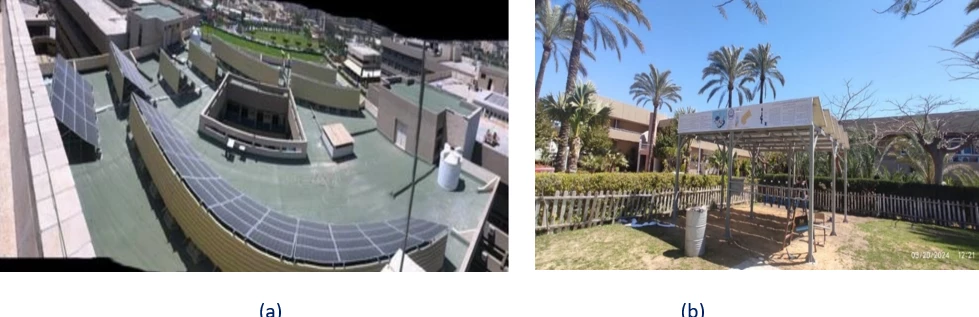
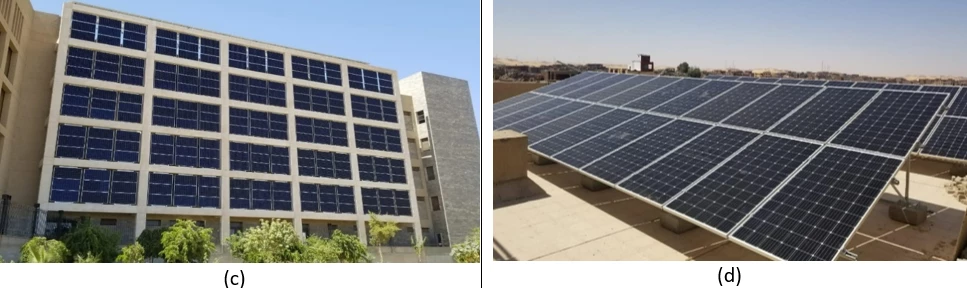
Figure 1: Solar installation in AASTMT campuses (a) 50kW grid tied PV station - Abukir Campus, (b) 10kW Solar PV system for Irrigation Pumping and water Treatment- Abukir Campus, (c) 100kW PV plant on-grid side plant-Aswan campus, (d) 50kW PV plant roof mounted on-grid -Aswan campus,
- Investments in Energy-related LABs intalled in AASTMT different campuses to guarantee continuous maintenance and improvements, thus assisting in consultancy, research and trainings.
These Labs include;
Eletrical Energy Engineering LAB
Environmental Monitoring and Climate Change Laboratory
Renewable Energy Lab in EE Dept-AAST Abukir
2. AASTMT 2025 Plan
- The Renewable Energy Unit is planning to further expand AASTMT’s renewable energy infrastructure through the installation of a 2kW Vertical Axis Wind Turbine (VAWT), funded by an internal AASTMT research grant. The wind turbine is integrated with the existing PV Plant, as shown in Figure 2, establishing a hybrid wind–solar energy system that supports sustainable electricity generation, innovative academic research, and hands-on student training. This initiative reinforces AASTMT’s commitment to renewable energy innovation, environmental sustainability, and the development of integrated clean energy technologies.
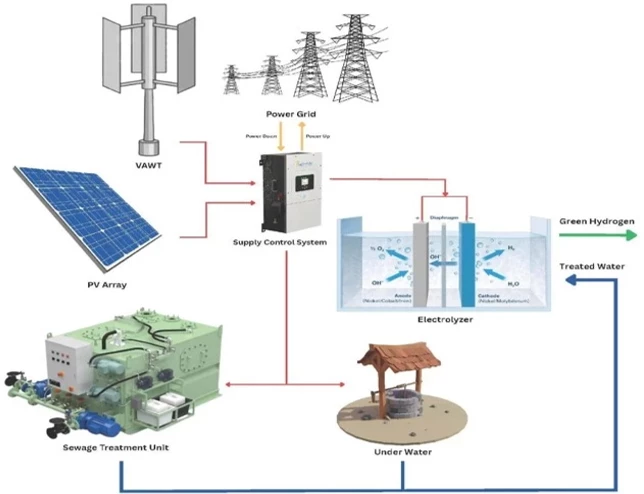
Figure 2. 2kW Vertical Axis Wind Turbine (VAWT)
- Study the potential of expanding renewable infrastructure among different AASTMT campuses by installing new solar stations and other renewable solutions. See 2024/2025 proposal to establish a solar power plant and two electric vehicle charging units at the College of Eng. and Technology building – Alamein
2024/2025 Study and Proposal for establishing PV station and EV charging units in Alamein Branch
- Encourage renewable energy-related events and activities (campaigns, initiatives, seminars, workshops, visits and trainings).
Renewable Energy-related Events
Renewable Energy-related Activities
- Prioritize renewable energy and decarbonization research projects as shown in Table 1
Renewable Energy Research Projects
Table 1. Energy-related research projects participated by AASTMT
|
Project Name |
Start date |
End Date |
Link |
|
RESt4GREEN Energy efficiency, Renewable Energy Sources and smarT energy conservation for improved quality of life and a GREENer Mediterranean |
16/07/2025 |
15/7/2028 |
|
|
GREENOLIVE Solar-driven Decarbonization for Mediterranean Industries |
01/09/2025
|
31/08/2028
|
|
|
PRO-Green-LABs Promoting Integrated Green Competences for Sustainable Development in Architectural Education through Experiential Lab-based, Active Learning |
April 2024
|
March 2026 |
|
|
RURALITIES Climate smart, ecosystem-enhancing and knowledge-based rural expertise and training centres |
01/10/ 2023
|
30/10/2026 |
|
|
AI-ESI Strengthening education and research in Applied Informatics for Energy System Integration |
01/01/2022 |
31/12/2026 |
|
|
GreenMED Green Shipping Pathways Towards a Clean Energy Transition in the Mediterranean |
01/10/2023 |
31/12/2025 |
- As per AI-ESI (Applied Informatics for Energy System Integration) Project outcomes, postgraduate students are engaged to conduct AI studies in the fields of renewable energy and decarbonization, by offering opportunities of Fully funded MSc and PhD degrees and mobility in University of Stavanger.
Fully funded MSc and Phd degree-NORPART AI-ESI for AASTMT postgraduate students
Fully funded MSc Mobility- NORPART AI-ESI for AASTMT postgraduate students

Figure 3. NORPART AI-ESI Project outcomes
- Start preparing for the implementation of 2025 research projects outcomes to serve the industry and community effectively and resourcefully, especially Interreg NEXT MED projects (RESt4GREEN and GREENOLIVE) whose pilots to be implemented in AASTMT are shown in Table 2
RESt4GREEN and GREENOLIVE
Table 2. Project pilots to be implemented in AASTMT
|
Project |
Description of Project Pilot |
|
REST4 GREEN Project
|
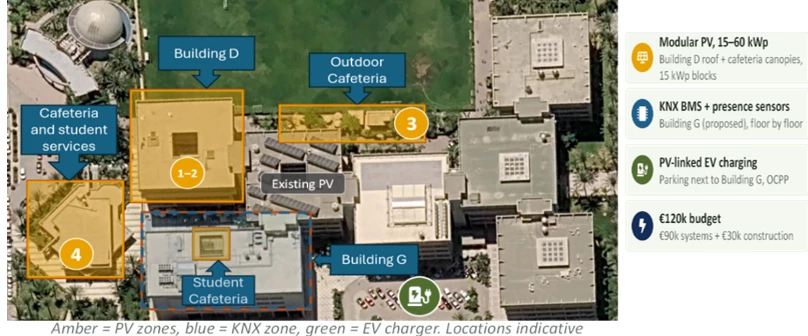
Proposed AASTMT Pilot as an Outcome of the REST4GREEN Project A system that integrates renewable energy, smart building technologies, and sustainable mobility within a campus environment. The pilot combines modular solar PV installations with a capacity of 15–60 kWp on Building D and cafeteria canopies, KNX-based building management and occupancy sensors in Building G, and solar-linked electric vehicle (EV) charging infrastructure. These technologies will be integrated into a unified monitoring framework using the campus SCADA system and the REST4GREEN dashboard to monitor PV generation, building electricity consumption, EV charging, and weather conditions. The Energy Research Unit will support simulation, commissioning, performance evaluation, and staff and student training. This pilot will translate the project's objectives into a demonstrable, replicable solution for improving campus energy performance and accelerating the transition towards smart, low-carbon university campuses.
|
|
GREEN OLIVE Project |
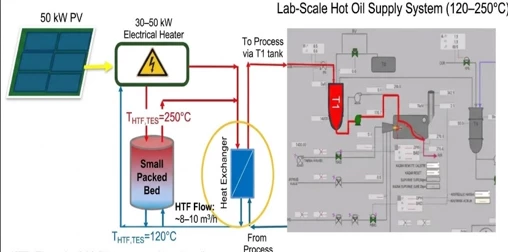
Lab-Scale Solar-Powered Hot Oil Supply and Thermal Energy Storage Pilot The proposed pilot consists of a 50kW photovoltaic (PV)-powered hot oil supply system, integrated with a 30–50 kW electrical heater and a small packed-bed thermal energy storage (TES) unit operating at temperatures ranging from 120°C to 250°C. A heat exchanger connects the storage system to an industrial process, demonstrating the potential for supplying renewable heat for industrial applications. Implementing this pilot at AASTMT will directly support clean sustainable energy by providing an advanced educational and research platform for solar energy integration, thermal energy storage, and energy efficiency. It will enable students and researchers to gain hands-on experience, investigate high-temperature heat storage performance, develop innovative renewable heating solutions, and explore alternatives to fossil-fuel-based industrial heating. Furthermore, the pilot will support graduation projects, postgraduate research, professional training, and scientific publications.
|
- Prioritize renewable energy projects in AASTMT Industry Service Complex to serve the industry and community effectively and resourcefully.
Renewable Energy-related 2024/2025 Projects in AASTMT Industry Service Complex include,
“Smart Solar Waste Compactor,” aims to develop an intelligent device for compacting plastic waste in various institutions such as schools, hospitals, and factories, relying primarily only on solar energy as its main power source. This project represents a practical solution that helps reduce plastic pollution, promotes concept of a circular economy, and encourages institutions to sort their waste and gain financial returns from it.
This is an integrated agricultural robot powered by solar energy and considered the second of its kind in the region. The robot was developed via joint funding from AASTMT and businessman Eng. Ahmed Abu Hashima in the project, named “LiDAR Navigation IoT Solar Agribot”. This project aims to support smart clean and sustainable farming and reduce reliance on manual labor, particularly in desert and muddy environments.
An environmental photobioreactor, powered by solar energy, is implemented to purify the air and produce oxygen using marine algae. The project is a low-cost version of a model used in the UAE, which costs around $10,000, while the students managed to build the unit in Egypt for less than 15,000 EGP. The amount of oxygen produced by this system is equivalent to that of ten mature trees, making it suitable for use in parks, schools, and crowded urban areas.

- Prioritize renewable energy graduation projects.
Renewable Energy Graduation Projects
Table 3: 2024/2025 Energy-related Graduation Projects in Electrical and Control Eng. Dept. – Abukir branch
AASTMT commitment to divert to renewable clean energy is vivid in its investments and research in the field of low-carbon sustainable energy as discussed before. Moreover, for further validation, the share of low-carbon sources in AASTMT energy supply is discussed in 2025 AASTMT Energy and Carbon Insights Report and summarized below;
According to the New and Renewable Energy Authority (NREA), Egypt’s total installed renewable energy capacity reached approximately 8.6 GW by the end of 2024/2025, compared with approximately 6.8 GW in 2023/2024, reflecting an increase of around 26% as shown in Figure 5 [NREA 2025].
https://nrea.gov.eg/test/en/Media/New/2999
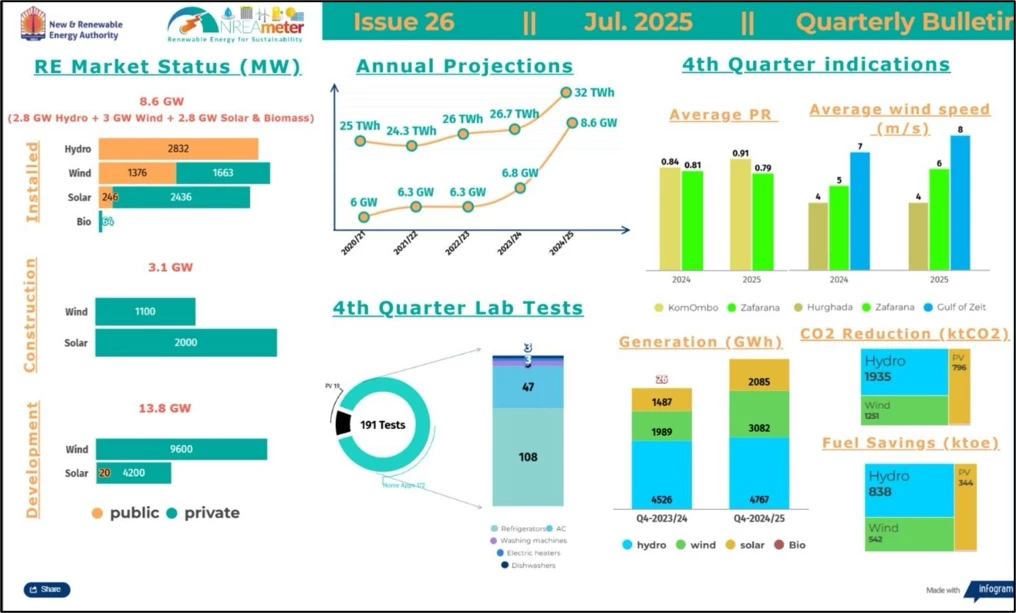
Figure 5. Renewable energy share in national grid [NREA Report 2025]
Since AASTMT’s electricity consumption is supplied mainly by the Egyptian national grid, this growth is reflected on AASTMT energy usage from low carbon sources, as shown in Table 4, where the average renewable energy share in supplying AASTMT total energy demand from national grid reached almost 26 % in 2025 which is more than the 25.1% in 2024. Besides renewable energy contributed in AASTMT from national grid, energy from solar energy installations across different AASTMT campuses buildings, has increased from 273.6GJ (75989kWh) in 2024 to 286.7GJ (79632kWh) in 2025 i.e. an increase of almost 4.78% from 2024 to 2025. This results in an increase of almost 1.08% in AASTMT total energy usage from low carbon energy sources (from national grid and solar installations) in 2025 compared to that in 2024 as shown in Figure 6.
Table 4. AASTMT Energy usage from low carbon sources in 2024 and 2025
|
Energy usage from low carbon sources (2024-2025) |
|
|
From national grid only |
2024: 17220.4 GJ 2025: 17396.14 GJ |
|
From solar installations only |
2024: 273.6 GJ 2025: 286.7 GJ |
|
From national grid and solar installations |
2024: 17494 GJ 2025: 17682.84 GJ |
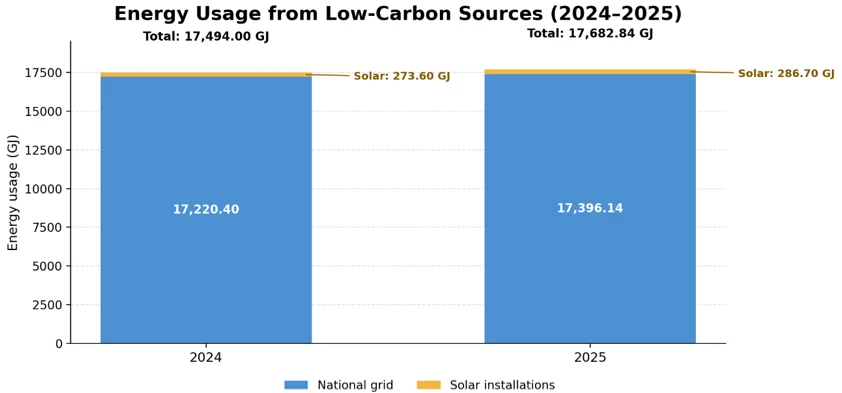
Figure 6. AASTMT Energy usage from low carbon sources in 2024 and 2025
Towards Green Renewable Energy Expansion, AASTMT takes consistent measures that are continuously carried out, besides yearly updated ones. This is reflected in the increase of low-carbon sources’ share in AASTMT total energy supply, as well as in the implemented innovations and prototypes of related projects and investment. These measures are detailed in AASTMT 2024 plan towards Green Sustainable Energy and their effectiveness are validated in 2024 Energy Progress Report, as summarized below.
AASTMT 2024 Plan towards Clean Sustainable Energy
AASTMT 2023/2024 Energy Progress Report
Starting from 2022 along to 2024, AASTMT took consistent steps towards renewable energy (RE) sources employment, with a particular focus on solar power, by installing and functioning about 230 kW solar of photovoltaic (PV) side and mounted stations as well as solar heaters as follows,

However, to sustain and expand AASTMT efforts towards renewable energy solutions, regular measures are taken into account, besides initiatives and projects initiated annually to serve this goal.
1. Regular Measures
These Labs include;
# Energy Research Unit LAB in 7th Engineerring Building - Alexandria Headquarter
# Energy LAB in Eletrical Energy Engineering Department - Smart Village Campus
Eletrical Energy Engineering LAB
# Environmental Monitoring and Climate Change Laboratory - Scientific Research & Innovation Centre
Environmental Monitoring and Climate Change Laboratory
2. AASTMT 2024 Plan
Annually, AASTMT participates in renewable energy-related projects and improves the outcomes of already existing ones to serve the industry and community effectively and resourcefully. Besides, campaigns and technical talks are organized to increase the awareness about RE importance and technicality. Moreover, studies are conducted for renewables expansion in AASTMT infrastructure and facilities.
2024/2025 Study and Proposal for establishing PV station and EV charging units in Alamein Branch
It presents the essential need to prepare students with a comprehensive background in renewable energies via three experimental kits. These lab experiments help the students understand the main concepts regarding renewable energy, energy measurement and energy storage. The three main resources are Solar, Wind and Fuel Cell. The laboratory serves renewable energy courses and summer school camps.
Renewable Energy Lab in EE Dept-AAST Abukir

The Renewable, Innovative and Integrated Water Treatment Unit designed in 2023 in the TREATMENT Project was installed and put into action in 2024. This unit uses energy harnessed from 7kW photovoltaic system to be used to lift water from a well, and subsequently, the water is directed through the four-stage nano-filter, where it undergoes a rigorous purification process. The end result is clean, potable water or water suitable for irrigation and cultivation and almost 7kW PV system, serves as the sustainable energy source for the three-phase pump.
Water Treatment Unit Report-May2024

Renewable Energy-related Events
Renewable Energy-related Activities
Renewable Energy Research Projects
Renewable Energy Graduation Projects
Renewable Energy-related 2024/2025 Projects in AASTMT Industry Service Complex include,
# Smart Solar Waste Compactor
“Smart Solar Waste Compactor” aims to develop an intelligent device for compacting plastic waste in various institutions such as schools, hospitals, and factories, relying primarily only on solar energy as its main power source. This project represents a practical solution that helps reduce plastic pollution, promotes the concept of a circular economy, and encourages institutions to sort their waste and gain financial returns from it.
# Solar Agricultural Robot
This is an integrated agricultural robot powered by solar energy and considered the second of its kind in the region. The robot was developed through joint funding from AASTMT and businessman Eng. Ahmed Abu Hashima in the project, named “LiDAR Navigation IoT Solar Agribot”. This project aims to support smart clean and sustainable farming and reduce reliance on manual labor, particularly in desert and muddy environments.
# Liquid Tree
An environmental photobioreactor, powered by solar energy, is implemented to purify the air and produce oxygen using marine algae. The project is a low-cost version of a model used in the UAE, which costs around $10,000, while the students managed to build the unit in Egypt for less than 15,000 EGP. The amount of oxygen produced by this system is equivalent to that of ten mature trees, making it suitable for use in parks, schools, and crowded urban areas.
AAST commitment to divert to renewable clean energy is vivid in its investments and research in the field of low-carbon sustainable energy as discussed before. Moreover, for further validation, the share of low-carbon sources in AASTMT energy supply is discussed in 2024 AASTMT Energy and Carbon Insights Report and summarized below;
AASTMT 2024 Energy and Carbon Insights
AASTMT energy demand is supplied mainly from the Egyptian national grid in which the renewable energy (RE) share has increased from 6.3GW in 2022 to 6.7Gw in 2023 till reaching 8.6GW in 2024 as per NREA Report 2024, achieving an increase by almost 6.3% from 2022 to 2023 and by 28.4% from 2023 till 2024 as shown in Fig.5. Besides renewable energy contributed in AASTMT from national grid, there are almost 230 kW solar energy installations on AASTMT campuses buildings, with production reaching almost 75989 kWh in 2024. The latter shows an increase of almost 1.3% from the 75000 kWh solar installations in 2023 as shown in Fig. 5.
This reflects AASTMT efforts to divert to clean energy, energy efficiency, reduce emissions and sustain serving the Environment. Conclusively, AASTMT average renewable energy share in supplying its total energy demand (including RE share in national grid and its solar installations) reached above 25% in 2024 which is more than the 24% in 2023, reflecting AAST continuous efforts and investments to increase its RES installations, meeting its roadmap of achieving 25% RES share by 2025 and progressing towards it long-term goal of 40% RES share by 2040.

Table 1 shows the entire AAST energy density, including energy from national grid and from AASTMT total solar installations, in kWh/m2 and GJ/m2 in 2024 compared to that of 2023. The calculated energy density reached about 0.09363GJ/m2 in 2024 which is less than the 0.09785GJ/m2 in 2023 by almost 4.3%, mirroring AASTMT continuous efforts towards electrical energy conservation and energy efficiency improvement. Also, it is worth noting that AASTMT total energy consumption from low carbon sources (summing up RE sources share in national grid and solar installation in AAST), has reached 17494GJ in 2024 which is more than the 17271GJ in 2023 by almost 1.29%, reflecting AASST support to transition to clean energy.
Table 1. Energy Density in GJ/m2 for the entire AAST in 2024 compared to 2023
|
Year |
Total Floor Area (m2) |
Total energy (kWh) (from Grid + AAST solar infrastructure) |
Total energy (GJ) (from Grid + AASTMT solar infrastructure) |
Density (GJ/m2) |
Energy from low carbon sources (GJ) |
|
2023 |
735569.7 |
19,992,470 |
71972.892 |
0.09785 |
17271 |
|
2024 |
735569.7 |
19,131,865 |
68874.714 |
0.09363 |
17494 |