



 Goal 15. Life on Land
AASTMT Water Discharge Standards and Guidelines
Download the full policy (PDF)
1. Purpose
The Arab Academy for Science, Technology and Maritime Transport (AASTMT) sets out in this document the water quality standards and guidelines that apply to all water discharged from its campuses, facilities and training vessels. The purpose is to uphold water quality in the receiving environment and to protect aquatic and terrestrial ecosystems, soil and groundwater, wildlife, and human health and welfare. It supports AASTMT’s commitment to SDG 6 (Clean Water and Sanitation), SDG 14 (Life Below Water) and SDG 15 (Life on Land), and reflects the location of several AASTMT campuses on the Mediterranean coast, near Lake Manzala and on the Nile.
2. Scope
These standards and guidelines apply to:
- all 8 AASTMT campuses in Egypt: Alexandria (Abu Qir, Miami), Cairo (Heliopolis), Giza (Dokki, Smart Village), Matrouh (El Alamein, including the AASTMT Alamein Hospital), Port Said and Aswan (South Valley);
- all sources of wastewater, including sanitary facilities, kitchens and cafeterias, student accommodation, hotels, clinics and the hospital, teaching and research laboratories, workshops, simulators, swimming pools, cooling systems, vehicle maintenance areas and landscape irrigation;
- AASTMT training and research vessels;
- staff, students, visitors, contractors and tenants on AASTMT premises.
3. Objectives and Commitments
- Protect ecosystems: release no untreated or polluted water into the sea, the Nile, lakes, drains or groundwater.
- Comply and do better: meet every Egyptian discharge standard at every campus, and go beyond it where we can.
- Reuse more water: raise the share of campus water from non-potable sources (groundwater, rain and treated water) from 27.8% to 35% by 2028.
- Measure everything: record the discharge flow of every campus monthly and test its quality at least every quarter by 2027.
- Engage people: train staff, students and contractors in pollution prevention and spill response.
AASTMT shall:
- comply, as a minimum, with the Egyptian discharge standards in this document, and apply any stricter limit set by a permit, a utility contract or an AASTMT procedure;
- discharge routine wastewater only to the public sewer network or to an approved treatment system, and never discharge untreated wastewater to the sea, coastal waters, the Nile, canals, agricultural drains, stormwater drains or the ground;
- keep hazardous liquids (laboratory chemicals, solvents, oils, fuels, medicines, disinfectant concentrates) out of all drains and hand them to licensed contractors;
- reduce wastewater at source through water efficiency, recirculation and reuse;
- reuse treated wastewater only where it meets the applicable Egyptian code;
- monitor discharge quality, act on any exceedance and keep records;
- publish this document and report on its implementation.
4. Discharge Standards
Water Conscious Building Standards
AASTMT operates in full alignment with Egyptian national building and environmental standards, so that all construction and operational activities meet regulatory requirements for sustainable resource management. Compliance with the Egyptian Code of Sanitary Installations in Buildings guarantees the safe design and maintenance of plumbing systems, effective water distribution and wastewater disposal that protects public health. Adherence to Law No. 202 of 2020 on Waste Management and Decree No. 44 of 2000 on liquid waste disposal reinforces AASTMT’s commitment to reducing water pollution, preventing hazardous discharges and promoting environmentally sound waste management, in line with SDG 6, SDG 11 and SDG 13.
Compliance with Egyptian Regulations
AASTMT is committed to safeguarding water resources and ensuring that its campuses meet the highest environmental and governmental standards. In compliance with Egyptian regulations, AASTMT follows a comprehensive framework for water discharge and wastewater management that prevents pollution, keeps potable water and wastewater systems separate, and guarantees the safe disposal of hazardous waste.
- Wastewater discharge: all wastewater is directed to a governmental treatment plant through a centralised sewage collection system at each campus, connected to the public utility treatment company of the city, under Law No. 93 of 1962 and Decree No. 44 of 2000.
- Protection of waterways: Law No. 48 of 1982 on the protection of the Nile River and waterways from pollution, for any discharge to the Nile, canals, drains and groundwater.
- Environmental protection and hazardous substances: Environment Law No. 4 of 1994 as amended by Law No. 9 of 2009, and Waste Management Law No. 202 of 2020.
- Groundwater wells: Water Resources and Irrigation Law No. 147 of 2021.
- Reuse of treated water: Egyptian Code ECP 501/2015.
- Networks: Egyptian Code 102 (2010) for the Design and Implementation of Drinking Water and Sewage Networks, and the Egyptian Code of Sanitary Installations in Buildings.
Discharge Routes and Applicable Standards
| Discharge route | Applicable standard | AASTMT rule |
|---|---|---|
| Public sewer network | Law No. 93 of 1962 and its executive regulations (Decree No. 44 of 2000) | Permitted routine route; limits in the table below |
| Sea and coastal waters | Environment Law No. 4 of 1994 as amended (including Law No. 9 of 2009) and its Executive Regulations (Prime Ministerial Decree No. 338 of 1995 as amended), Annex 1 | Prohibited without a written permit from the competent authority |
| Nile, canals and agricultural drains | Law No. 48 of 1982 on the protection of the River Nile and waterways from pollution, and its executive regulations | Prohibited without a written permit from the competent authority |
| Reuse of treated wastewater for irrigation | Egyptian Code ECP 501/2015 | Permitted only where test results meet the code |
| Training and research vessels | MARPOL Annex I (oil) and Annex IV (sewage), and Law No. 4 of 1994 provisions on marine pollution from ships | Discharge only as MARPOL allows; otherwise port reception facilities |
| Hazardous liquid waste | Waste Management Law No. 202 of 2020 | Never to any drain; licensed contractor only (see the AASTMT Policy on Hazardous Waste Disposal) |
Discharge Quality Standards
Wastewater leaving an AASTMT campus for the public sewer must meet the limits of the executive regulations of Law No. 93 of 1962 as amended by Decree No. 44 of 2000. The main parameters tested are:
| Parameter | Limit for discharge to public sewer | AASTMT testing |
|---|---|---|
| pH | 6 – 9.5 | Monthly at Abu Qir; at least quarterly at other campuses from 2027 |
| Temperature | Not more than 43 °C | Monthly at Abu Qir; at least quarterly at other campuses from 2027 |
| Biochemical oxygen demand (BOD) | Not more than 600 mg/L | Monthly at Abu Qir; at least quarterly at other campuses from 2027 |
| Chemical oxygen demand (COD) | Not more than 1,100 mg/L | Monthly at Abu Qir; at least quarterly at other campuses from 2027 |
| Total suspended solids (TSS) | Not more than 800 mg/L | Monthly at Abu Qir; at least quarterly at other campuses from 2027 |
| Oil and grease | Not more than 100 mg/L | Monthly at Abu Qir; at least quarterly at other campuses from 2027 |
| Turbidity | Recorded to track treatment performance | Monthly at Abu Qir; at least quarterly at other campuses from 2027 |
| Flow | Recorded by flowmeter | Monthly |
- Treated water reused on campus meets the grade of Egyptian Code ECP 501/2015 for its use, and is never used for drinking.
- Nothing hazardous may be discharged: no solvents, acids, heavy metals, oils, paints, medicines, pesticides or microbiological cultures go down sinks or drains.
5. Guidelines by Type of Discharge
- Sanitary wastewater: separate, sealed UPVC networks for sewage, rainwater and greywater, laid at slopes of 0.5–1% with inspection chambers and manholes, so that wastewater cannot leak into soil or groundwater.
- Laboratory and medical wastewater: chemical waste is collected separately and neutralised in neutralisation pits before any discharge; hospital wastewater is treated on site.
- Kitchens and cafeterias: grease traps on every kitchen drain, cleaned regularly; used cooking oil collected for recycling, never poured into drains.
- Rainwater and runoff: harvested for gardens and greenhouses; drains kept free of litter, fuel and chemicals; vehicles washed only where the water is collected.
- Irrigation, fertilisers and pesticides: drip lines, bubblers and perforated pipes instead of flooding so that no water runs off; compost and integrated pest management, with no chemicals applied before rain or near drains.
- Aquaculture and research: closed, recirculating systems; nutrient-rich water reused in hydroponics; any water released is screened so that no live organisms leave the system.
- Units with specialised effluents (the Aquaculture Research Center, chemistry and marine science laboratories, engineering workshops, clinics and the hospital) keep a local procedure that applies these standards. The Aquarium Water Recirculation, Reuse and Discharge Policy (AASTMT-ARC-WDM-01) is the first such procedure.
- Construction and maintenance: contractors keep soil, cement and wash water out of drains under their contracts.
- Training ships: sewage, oily water and garbage are discharged only as MARPOL Annexes I, IV and V allow or to port reception facilities, and ballast water is managed under the IMO Ballast Water Management Convention.
6. How Each Campus Applies These Guidelines
All AASTMT campuses in Egypt send their wastewater through a centralised sewage collection system to the public utility treatment company of their city. Some campuses also treat and reuse water on site.
| Campus | Where the water goes | Treatment and reuse | Monitoring |
|---|---|---|---|
| Alexandria – Abu Qir (main campus) | Sealed network to the 12 m³ sump and pump station (Annex A), then to the public sewer of Abu Qir Ash Sharqiyah and the municipal treatment plant. Rainwater goes to the gardens. | 13 wells irrigate 25 acres of gardens; 27.8% of water from groundwater and rain; closed hydroponics and 10 rain tanks at the Aquaculture Research Center. | Flow monthly; discharge quality monthly; groundwater monthly; pump station checks monthly to twice a year |
| Matrouh – El Alamein (campus and AASTMT Alamein Hospital) | Medical and laboratory wastewater goes to an on-site treatment unit. Hospital stormwater flows through gully traps, inspection chambers and manholes (pipes sloped at 0.5%) to free discharge points on the southern edge. Campus rainwater joins the New Alamein Authority network, which reuses it for irrigation. The stormwater network is separate from the medical and laboratory wastewater, which goes to the on-site treatment unit, and the discharge points are inspected regularly. | Screening and sedimentation, aerobic biological treatment, chlorine and UV disinfection, filtration and reverse osmosis; treated water reused for irrigation, toilet flushing and cleaning. Colour-coded waste segregation. | Treated effluent tested before reuse |
| Giza – Smart Village | Public sewer to the Western Treatment Plant in 6th of October City. | Drip irrigation of green areas. | At least quarterly from 2027 |
| Cairo – Heliopolis | Public sewer to the Cairo treatment plants. | Water-saving fixtures. | At least quarterly from 2027 |
| Giza – Dokki | Public sewer of the Giza sanitary drainage network. | Water-saving fixtures. | At least quarterly from 2027 |
| Alexandria – Miami | Public sewer of the Alexandria sanitary drainage network. | Water-saving fixtures. | At least quarterly from 2027 |
| Port Said | Public sewer; no discharge to Lake Manzala or the sea. | Water-saving fixtures. | At least quarterly from 2027 |
| Aswan – South Valley | Public sewer; no discharge to the Nile. | Green walls irrigated by drip lines. | At least quarterly from 2027 |
7. Monitoring, Validation and Records
Operational Guidelines and Maintenance Standards
- Routine inspections: inspect the sump, pump room and valve configuration twice a year for performance and compliance with safety and environmental standards.
- Discharge quality monitoring: test the discharge for pH, turbidity and pollutant levels against the standards above.
- Seasonal adjustments: adjust discharge operations to seasonal rainfall to prevent overflow and protect the receiving environment.
- Emergency protocols: keep response plans for pump failure or overflow, using the dual control panels, and train staff in spill containment and mitigation.
- Stakeholder engagement: hold workshops and work with environmental organisations and with the utility company of Abu Qir Ash Sharqiyah, Alexandria, to promote sustainable water practices.
- Register of discharge points: each campus keeps a register of discharge points, showing location, source, discharge route and responsible person.
- Sampling and testing: final effluent at each campus sewer connection is sampled and tested by an accredited laboratory at the frequencies in the limits table.
- Exceedances: any exceedance is investigated, corrected within 30 days, retested and reported to the Sustainability Office and the SDGs Workforce Committee.
- Records: test reports, registers and incident records are kept for at least five years.
Validation
| Validation | Criteria | Method | Frequency |
|---|---|---|---|
| System capacity | Sump must handle up to 12 cubic metres | Capacity test | Twice a year |
| Pump flow rate | Each pump discharges 60–70 cubic metres per hour | Flow rate test | Monthly |
| Battery and valve configuration | Check and shut-off valves operate smoothly and regulate discharge | Functional check | Monthly |
| Control panel operation | Panels manage discharge flow and respond to real-time monitoring | Operation test | Quarterly |
| Discharge water quality | Meets the discharge quality standards above | Laboratory analysis | Monthly |
| Discharge volume | Flow recorded for every campus | Flowmeter reading | Monthly |
| Groundwater for irrigation | Meets irrigation water specifications | Laboratory analysis | Monthly |
| Routine maintenance | Sump, pump room and valves inspected | Visual and functional inspection | Twice a year |
8. Spills and Emergencies
- Stop and contain: stop the source and block nearby drains with spill kits kept in laboratories, workshops, kitchens and pump rooms.
- Report: tell Facilities and the Sustainability Office within one hour; they inform the water company or the Egyptian Environmental Affairs Agency if polluted water has reached a sewer, drain, the sea or the ground.
- Clean up and learn: clean the area with licensed contractors and record the incident, its cause, the corrective and preventive actions taken and the lesson learned.
- Train: run spill-response training for staff, students and contractors twice a year.
9. Responsibilities
| Task | Responsible party | Role |
|---|---|---|
| Daily cleaning and disinfection | Contracted company (workers and plumbers) | Keep pipes clear to prevent blockage |
| System monitoring | Control room operators | Monitor pump operations and discharge flow |
| Routine inspections | AASTMT maintenance team | Conduct inspections twice a year |
| Authorisation and oversight | AASTMT Facilities Management and Maintenance team | Oversee system authorisation and compliance |
| Campus implementation | Branch directors and campus facilities teams | Apply these guidelines and send flow and test records each quarter |
| Laboratories, hospital and kitchens | Laboratory, hospital and kitchen managers | Keep hazardous and greasy waste out of drains |
| Stakeholder engagement workshops | SDG 6 and SDG 15 officers | Coordinate with environmental organisations |
| Yearly public report | SDG 15 officer and Sustainability Office | Publish discharge volumes, test results, reuse and incidents |
10. Reporting and Engagement
- Yearly public report: From 2027, the SDG 15 officer and the Sustainability Office publish a yearly public report of discharge volumes, test results, reuse and incidents.
Environmental Standards and Certifications
- ISO 14001: AASTMT applies the ISO 14001 environmental management framework to manage its environmental responsibilities.
- Consumption and Recycling Policy: reduces waste and promotes the sustainable use of resources.
- Water usage practices: teach staff and students to conserve water and minimise pollution.
- Workshops and training: regular wastewater treatment workshops and awareness campaigns with students, staff and local communities.
Awareness and Community Engagement
- Wastewater treatment awareness: campaigns and funded projects spread knowledge of safe wastewater management.
- Workshops with stakeholders: programmes with local communities, municipalities and governmental authorities.
- Scientific research and innovation: AASTMT staff and students research wastewater treatment, green infrastructure and sustainable campus operations, including a solar-powered reverse-osmosis pilot unit.
11. Review Programme
| Item | Detail |
|---|---|
| Document title | AASTMT Water Discharge Standards and Guidelines |
| Date created | August 2023 |
| Approving body | SDGs Workforce Committee |
| Version | 3 |
| Last review date | October 2026 |
| Next review date | 2027 |
| Document owners | SDGs Workforce Committee (approving body), through the SDG 15 officer and the Sustainability Office |
| Scientific contributors | Dean for Postgraduate Studies and Scientific Research, College of Maritime Transport and Technology (CMTT); Petrochemical and Chemical Engineering, College of Engineering and Technology; Pharmaceutical Sciences Department, College of Pharmacy |
| Lead contacts | SDG 15 officer; Sustainability Office |
| Approval signature |
Dean of Scientific Research and Innovation |

Annex A. The Abu Qir Campus Wastewater and Rainwater System
System Description
Effective water management is crucial to AASTMT’s commitment to sustainability and to achieving SDG 6, SDG 14 and SDG 15. The sewage plant and rainwater system at Abu Qir, Alexandria, is designed to handle wastewater and rainwater from specified areas, excluding student housing, hotels, presidential buildings and restaurants. Their wastewater also goes to the public sewer network, as for all campus wastewater (Section 4), and the same standards apply to them.
The Drainage Network
The drainage network extends between these buildings and reaches the wastewater and rainwater collection pit located behind the buildings of the College of Architecture and Computers, through a sloped line 12 inches in diameter, into the current collection pit of 2 × 2 metres.
Sump Specifications
- Dimensions: the main sump is fed by the 12-inch line and measures approximately 2 × 2 metres.
- Storage capacity: an effective storage capacity of about 12 cubic metres lets the sump handle high inflows at peak times and during heavy rain.
Pump Room Specifications
- Submersible pumps: two EBARA submersible pumps of 10 horsepower each, discharging 60–70 cubic metres per hour.
- Self-priming horizontal dry pumps: two additional Siemens dry pumps of 15 horsepower each, self-priming, providing reliable backup.
Battery and Valve Configuration
- Battery system: five outlets, each 12 inches in diameter, giving flexibility in discharge regulation.
- Check and shut-off valves: four 4-inch and one 6-inch check valves, with a matching set of shut-off valves, allowing precise flow control and isolation during maintenance.
Control Room and Electrical Panels
- Control panels: two electrical control panels manage pump operations and discharge flow, ensuring optimised, safe operation.
- Backup and monitoring: redundant control mechanisms minimise the risk of overflow or discharge problems.
Wastewater Network and Outflow Connections
- Pipeline dimensions: the network starts with a 12-inch line that tapers to 8 inches before connecting to the main external discharge line.
- External discharge line: wastewater is channelled to the public drainage system of the utility company of Abu Qir Ash Sharqiyah, Alexandria, and from there to the municipal treatment plant, in line with local standards for safe discharge.
- Flow metering: the discharge is measured by flowmeters and recorded every month.
Illustrative Pictures of the Station
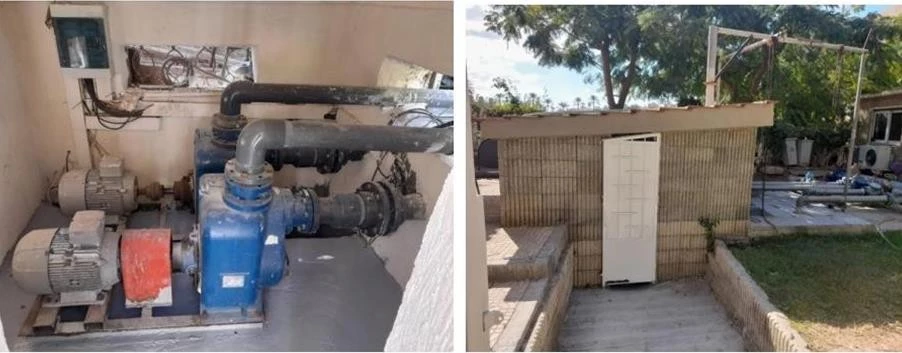
Pump room: submersible and self-priming pumps
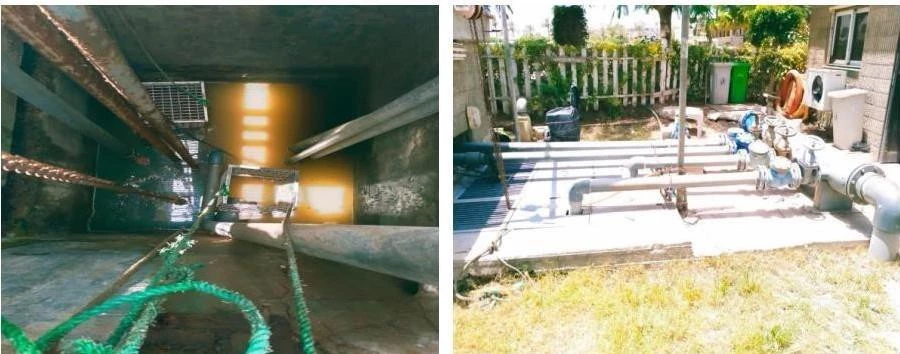
The battery and the field
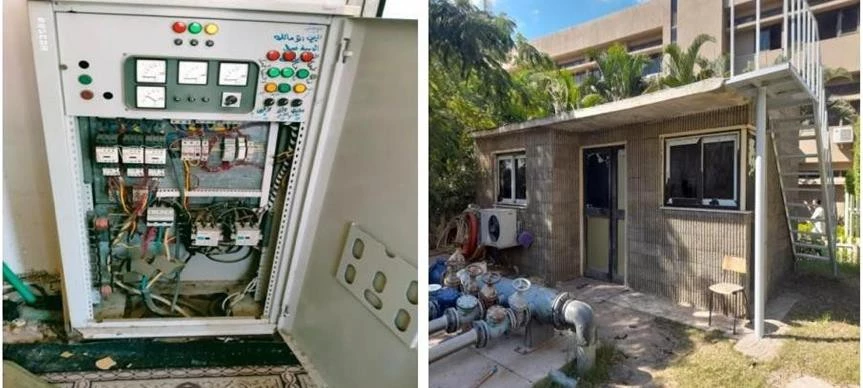
Control room: the electrical control panels
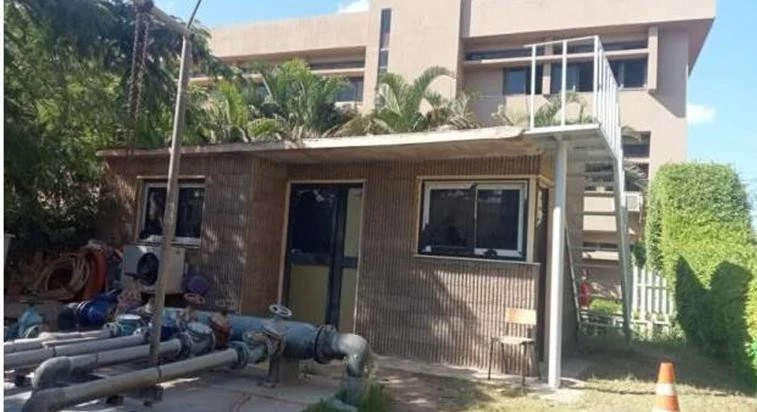
Valves and discharge lines at the pump station
Control and Monitoring System
- Control room: houses the two electrical control panels that manage pump operations, discharge flow and real-time system monitoring.
- Redundant systems: if one control panel fails, the other keeps the system running and prevents overflow or other discharge problems.
- Pressurised outflow: continuous pressure in the discharge line keeps wastewater moving and ensures compliance with local drainage standards.
- Daily cleaning contract: a contracted company of workers and plumbers, selected from among several companies, cleans and disinfects all pump rooms daily so that no blockage occurs in the pipes that could lead to leakage.
Water and Groundwater on the Abu Qir Campus
- Groundwater for irrigation: 13 borehole wells irrigate about 25 acres of gardens and palm groves and supply the fire-protection system; 115,000 m³ was extracted in 2022-2023, and the water is analysed monthly against irrigation specifications.
- Rainwater: rainwater from roofs and walkways is channelled into planting beds and green areas, and drainage inlets connected to deep perforated pipes let it soak into the ground to recharge groundwater.
- Aquaculture Research Center: closed hydroponic and aquaponic systems, in use for more than 12 years, reuse water and use 90% less than conventional farming; rainwater is stored in ten 500-litre roof tanks.
- Non-potable share: 27.8% of campus water comes from groundwater and harvested rain.
Annex B. Separation of Potable Water and Wastewater
AASTMT enforces Egyptian Code 102 (2010) so that potable water is always kept apart from wastewater:
- Dual pipeline systems: distinct pipelines for potable water and wastewater in all facilities prevent cross-contamination.
- Backflow prevention devices: installed and maintained so that wastewater cannot re-enter potable systems.
- Routine inspections and audits: cover potable water pipes, wastewater lines, valves, sewage manholes, rain gutters and building roofs, using a checklist for all pipes and sanitation and a plan of inspection points.
- Water storage and supply safety: potable water is stored in separate tanks isolated from sewage lines, with monitoring to ensure supply safety.
- Redundant monitoring and control: backup control panels prevent overflow or accidental discharge if one fails.
Campus plans show potable water pipelines in red and wastewater in blue; in laboratories, green pipes carry potable water and grey pipes carry drainage.
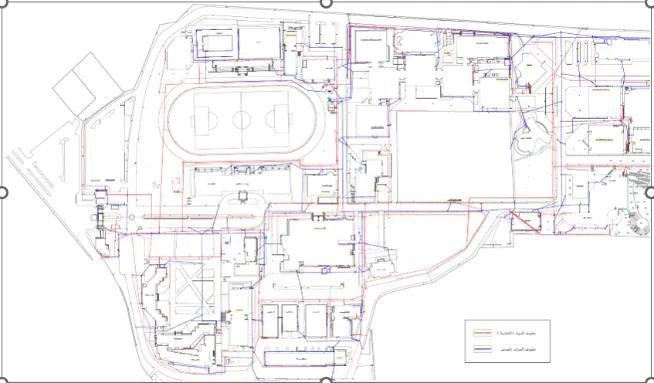
Campus plan showing potable water (red) and wastewater (blue) networks
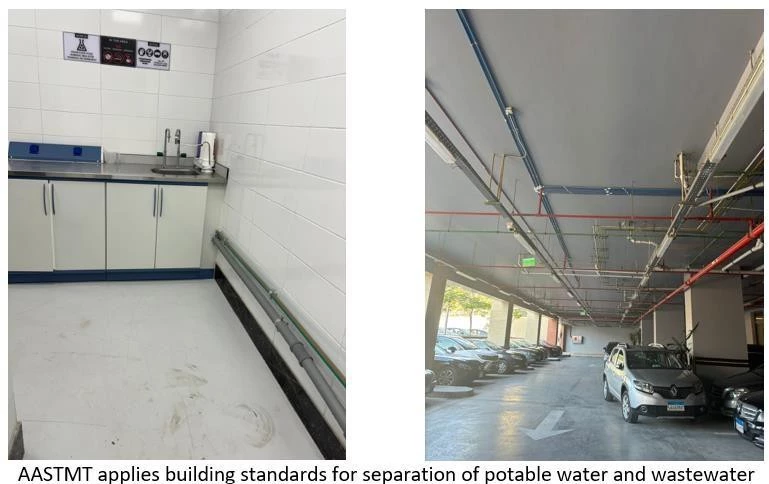
AASTMT applies building standards for the separation of potable water and wastewater
Annex C. Laboratory Waste
Laboratory waste is managed under the AASTMT Policy on Hazardous Waste Disposal.
- Neutralisation: chemical wastewater from laboratories is neutralised in neutralisation pits before any discharge to the network.
- Nothing down the drains: no laboratory chemicals or biological waste go down sinks or drains.
This system keeps harmful chemicals, biological agents and pollutants out of water sources.
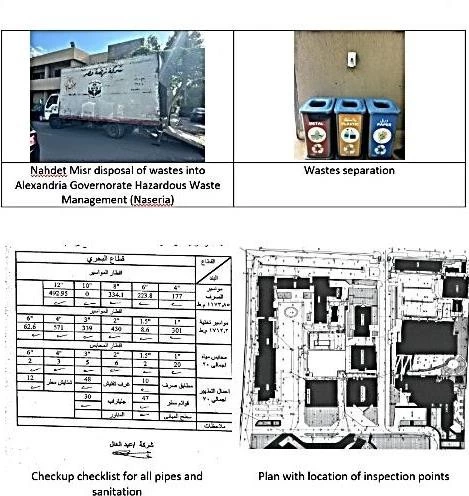
Nahdet Misr disposal to the Nasreya hazardous waste facility, waste separation, the checklist for pipes and sanitation, and the plan of inspection points
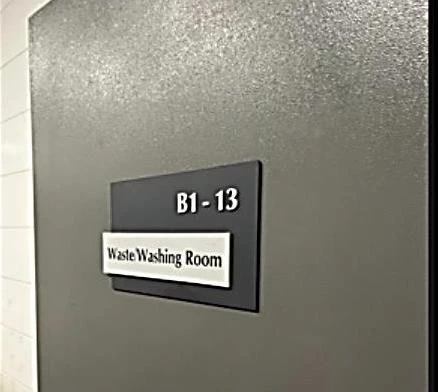
Dedicated waste washing room