



 Goal 15. Life on Land
15.4.1 Water discharge guidelines and standards
Download the full evidence (PDF)
2024-2025
AASTMT has water quality standards and guidelines for every wastewater discharge from its campuses, to uphold water quality, prevent water pollution and groundwater contamination, and protect ecosystems, wildlife, and human health and welfare. The “AASTMT Standards and Guidelines for Discharge of Wastewater” were created in August 2023 and reviewed in 2025 (Version 2). They set discharge limits under Egyptian law, specify the Abu Qir wastewater and rainwater system, keep potable water and wastewater apart, keep laboratory waste out of drains, and set how each campus tests and reports its discharge. The cases below show the standards applied in the academic year 2024-2025 (September 2024 to August 2025).
AASTMT Water Discharge Standards and Guidelines
The standards and guidelines for the water quality of all water discharged from AASTMT campuses, facilities and training vessels, to protect ecosystems, soil and groundwater, wildlife, and human health and welfare.
https://aast.edu/en/sdg/goals.php?unit_item=1215&page_id=121500067
Standards and Guidelines for Discharge of Wastewater, Version 2 (reviewed 2025, AASTMT Abu Qir Campus, Alexandria)
In 2025 the SDGs Workforce Committee reviewed AASTMT’s wastewater discharge guidelines. Version 2 specifies the Abu Qir wastewater and rainwater system: a 12-inch drainage line to a 12 m³ sump, two 10 hp EBARA submersible pumps discharging 60–70 m³ per hour with two 15 hp Siemens standby pumps, dual control panels to prevent overflow, and daily cleaning of the pump rooms by a contracted company. It sets a validation programme (pump flow and valves checked monthly, control panels quarterly, discharge water quality tested monthly by laboratory analysis, and sump and pump room inspected twice a year), and requires compliance with Law No. 93 of 1962, Decree No. 44 of 2000 and Egyptian Code 102 (2010), so that no contaminated water reaches the sea, freshwater or groundwater. The guidelines require discharge water to meet pH, turbidity and pollutant standards, with regular laboratory testing of pH, turbidity and pollutant levels. Version 2 was approved by the SDGs Workforce Committee (created August 2023, last reviewed 2025, next review 2026).
AASTMT Standards and Guidelines for Discharge of Wastewater
Monitoring the Discharge of the Abu Qir Campus (2024-2025, Abu Qir, Alexandria)
All wastewater from the Abu Qir campus passes through the campus pump station, where flowmeters record the discharge every month, before it enters the public sewer and the municipal treatment plant. Separate sewage, stormwater and greywater networks, sealed UPVC pipes and slopes of 0.5–1% stop wastewater from leaking into soil and groundwater.
UI GreenMetric 4.5: Consumption of treated water
Keeping Laboratory Waste out of Drains (2024-2025, AASTMT campuses in Alexandria)
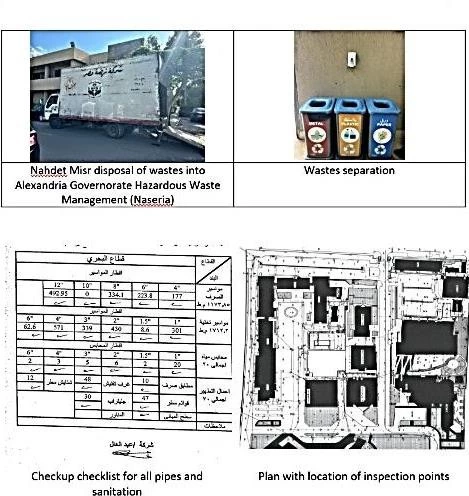
Chemical and biological waste from AASTMT laboratories is separated, neutralised where needed and stored in controlled campus facilities, and is collected twice a week by Nahdet Misr, a certified company, which takes it to the Alexandria Governorate hazardous waste management facility at Nasreya. Laboratories have separate pipes for potable water (green) and drainage (grey), and every pipe and sanitary fitting is checked against a checklist and a plan of inspection points. This keeps harmful chemicals and biological agents out of the sewer and the environment.
UI GreenMetric 4.6: Water pollution control in campus area

BRIEFDESCRIPTION
AASTMT plays a leading role in wastewater discharge management in Egypt by fully complying with national regulations and aligning with international environmental standards. Its comprehensive framework ensures that wastewater is collected, treated, and safely disposed, while potable water remains strictly separated and safeguarded. Through awareness programs, stakeholder engagement, and certified hazardous waste disposal, AASTMT demonstrates its commitment to sustainable water management and environmental stewardship. By integrating infrastructure, policy, research, and awareness, AASTMT sets a benchmark for Egyptian universities in managing water responsibly, protecting ecosystems, and contributing to the Sustainable Development Goals (SDG 6: Clean Water and Sanitation, SDG 12: Responsible Consumption, and SDG 15: Life on Land).This document is a thorough framework for regulating rainwater and wastewater outflow. In order to provide ecologically responsible water management throughout campus facilities, it provides system specifications, sustainability-focused solutions, combining system functionality with SDG-aligned practices to minimize environmental impact.
↵
System Description:
Effective water management is crucial to AASTMT's commitment to sustainability and achieving SDG 15. The sewage plant and rainwater system at Abu-Qir, Alexandria, is designed to handle wastewater and rainwater from specified areas, excluding student housing, hotels, presidential buildings, and restaurants.
The drainage networkL:
Extending between these buildings and reaches the wastewater and rainwater collection pit located behind the buildings of the College of Architecture and Computers. Through a slope line with a diameter of (12 inches) and the current cesspool with dimensions of (2 x 2 meters).
Sump Specifications:
- Dimensions: The main sump has a 12-inch diameter and measures approximately 2x2 meters.
- Storage Capacity: With an effective storage capacity of around 12 cubic meters, the sump can handle high inflows during peak times and heavy rain events.
Pump Room Specifications:
Submersible Pumps:
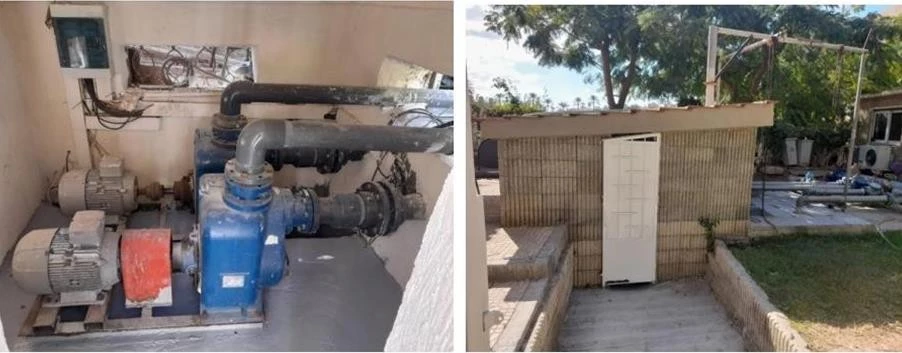
- Quantity: Two submersible pumps by EBARA.
- Horsepower: Each pump operates at 10 horsepower.
- Flow Rate: Discharges water at 60-70 cubic meters per hour.
- Self-Priming Horizontal Dry Pumps:
- Quantity: Two additional Siemens dry pumps, each with 15 horsepower, offering self-priming capabilities and reliable backup.
- Battery and Valve Configuration:
- Battery System: Features five outlets, each 12 inches in diameter, providing flexibility in discharge regulation.
- Valves:
- Check and Shut-off Valves: Include four 4-inch and one 6-inch check valves, and a matching set of shut-off valves, allowing for precise flow control and isolation during maintenance.
- Control Room and Electrical Panels:
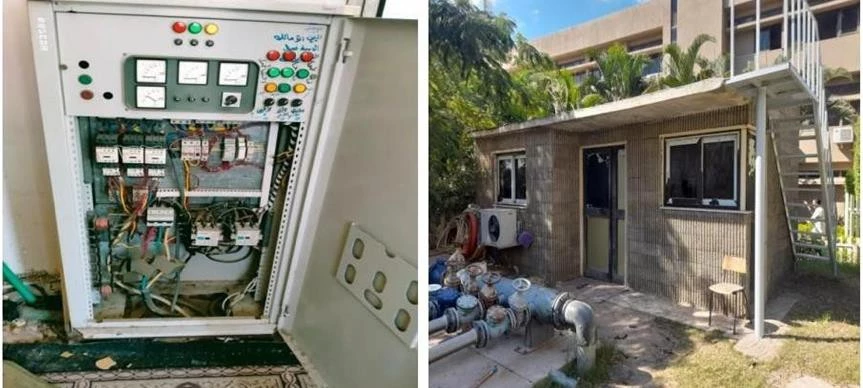
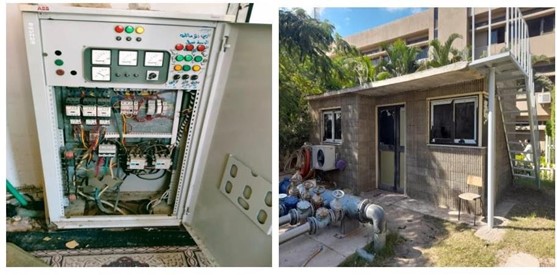
- Control Panels: Two electrical control panels manage pump operations and discharge flow, ensuring optimized, safe operations.
- Backup and Monitoring: Redundant control mechanisms minimize the risk of overflow or discharge issues, promoting reliability.
- Wastewater Network and Outflow Connections
- Pipeline Dimensions: The network starts with a 12-inch diameter line tapering to an 8-inch diameter before connecting to the main external discharge line.
- External Discharge Line: Wastewater is channeled to an external drainage system, aligning with local standards for safe water discharge.
Illustrative pictures of the station:
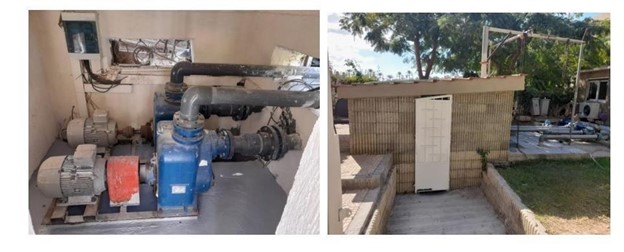
Pump Room
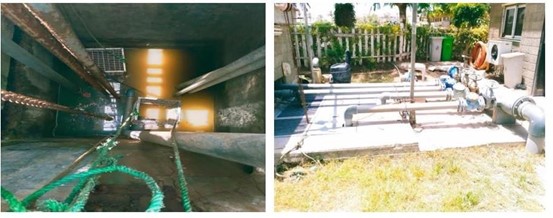
Control Room
The battery and the Field
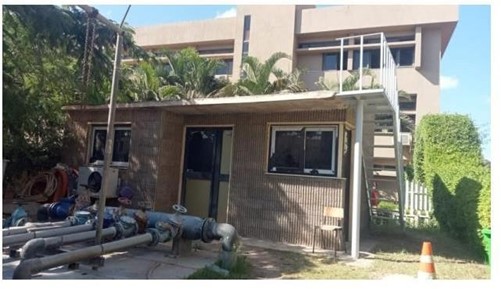
Valves
- Control and Monitoring System:
- Control Room: Houses two electrical control panels that manage pump operations, discharge flow, and real-time system monitoring.
- Redundant Systems: The dual control panel setup ensures that, in the event of a failure, one panel will maintain functionality to prevent overflow or other discharge issues.
- Pressurized Outflow: The discharge line begins with an 8-inch diameter that transitions to 12 inches, connected to the main external drainage line. This configuration supports continuous pressure to facilitate wastewater movement and ensure compliance with local drainage standards.
- Contract with company (workers and Plumbers) that is contracted and is selected from among a group of companies in order to carry out cleaning and disinfection work for all the pump rooms on a daily basis to ensure that no blockage occurs in the pipes that could lead to leakage.
- Water Conscious building Standards:
- AASTMT operates in full alignment with the Egyptian national building and environmental standards, ensuring that all construction and operational activities meet regulatory requirements for sustainable resource management. Compliance with the Egyptian Code of Sanitary Installations in Buildings guarantees the safe design and maintenance of plumbing systems, ensuring effective water distribution and wastewater disposal to protect public health. Furthermore, adherence to Law No. 202 of 2020 on Waste Management and Resolution No. 44 of 2000 on Liquid Waste Disposal reinforces AASTMT’s commitment to reducing water pollution, preventing hazardous discharges, and promoting environmentally sound waste management practices. These integrated measures reflect AASTMT’s scientific and institutional dedication to sustainability, environmental protection, and the achievement of national and global objectives, particularly those aligned with SDG 6 (Clean Water and Sanitation), SDG 11 (Sustainable Cities and Communities), and SDG 13 (Climate Action).
- Operational Guidelines and Maintenance Standards:
- Routine Inspections: Conduct bi-annual inspections of sump, pump room, and valve configurations to ensure optimal performance and compliance with safety and environmental standards.
- Discharge Quality Monitoring: Regular testing of discharge water for pH, turbidity, and pollutant levels to ensure alignment with environmental regulations.
- Seasonal Adjustments: Adjust discharge operations based on seasonal rainfall patterns, aiming to prevent overflow and maintain a balanced ecosystem impact.
- Emergency Protocols: the design of two electrical control panels manages pump operations and discharge flow, ensuring optimized, safe operations.
- Develop response plans in case of pump failure or overflow events, including staff training on spill containment and mitigation measures.
- Stakeholder Engagement: Regular workshops and collaborations with environmental organizations to promote sustainable water practices and utility company Abu Qir Ash Sharqiyah, Alexandria.
Validation
Validation criteria | Validation method | Frequency | |
System capacity | Sump must handle up to 12 cubic meters. | Capacity Test | Bi-annual |
Pump flow rate | Each pump should discharge 60-70 cubic meters per hour. | Flow Rate Test | Monthly |
Battery and valve configuration | Check valves and shut-off valves should operate smoothly and regulate discharge effectively. | Functional check | Monthly |
Control panel operation | Control panels must manage discharge flow and respond to real-time system monitoring. | Operation test | quarterly |
Discharge water quality | Water should meet pH, turbidity, and pollutant standards. | Quality Testing (Lab Analysis) | Monthly |
Routine maintenance | Routine Maintenance Bi-annual inspection of sump, pump room, and valves must be conducted. | Visual and Functional Inspection | Bi-annual |
Responsibility
Task | Responsible party | Role |
Daily Cleaning and Disinfection | Contracted Company (Workers & Plumbers) | Ensure pipes are clear to prevent blockage. |
System Monitoring | Control Room Operators | Monitor pump operations and discharge flow |
Routine Inspections | AASTMT Maintenance Team | Conduct bi-annual inspections. |
Authorization and Oversight | AASTMT Facilities Management & Maintenance Team | Oversee system authorization and compliance. |
Stakeholder Engagement Workshops | SDG 6 and 15 officers | Coordinate with environmental organizations. |
A Review Program
↵ ↵
Document title | AASTMT Standards and Guidelines for Discharge of Waste Water-updated guidelines (2025 Reviewed) ‘’A Supplementary Report to the Institutional Policy” |
Date Created: | August 2023 |
Approving Body: | SDGs Workforce Committee |
Version: | 2 |
Last Review Date | 2025 |
Next Review Date: | 2026 |
Document Owner: |
|
Lead Contact: | Prof. Dr. Kareem Tonbol TA. Elen Emad Officer. Ragga Ahmed |
Approval Signature | Dean of Scientific Research and Innovation |

Supplementary Report to the AASTMT’s Standards
and Guidelines for Discharge of Wastewater
Compliance with Egyptian Regulations:
AASTMT aligns its water management systems with Egyptian governmental authority regulations to prevent polluted water from entering natural watercourses. The framework reflects both mandatory national standards and international best practices
- Wastewater Discharge: All wastewater is directed to a governmental treatment plant through a centralized sewage collection system available at each campus. This system is connected to the public utility treatment company of the respective city, ensuring that all wastewater is treated according to nationally accepted levels.
- Waste Management Compliance: AASTMT applies building standards aligned with the Egyptian Standard for Waste Disposal, which sets strict rules for sustainable wastewater disposal and prevents contamination of surface or groundwater resources.
- Environmental Law Compliance: AASTMT adheres to Law No. 6/2009 and Law No. 9/1982 for hazardous waste management and environmental protection.
Framework for Separation of Potable and Wastewater
AASTMT strictly enforces the Egyptian Code 102 (2010) for the Design and Implementation of Drinking Water and Wastewater Networks, ensuring safe separation of potable water from wastewater systems:
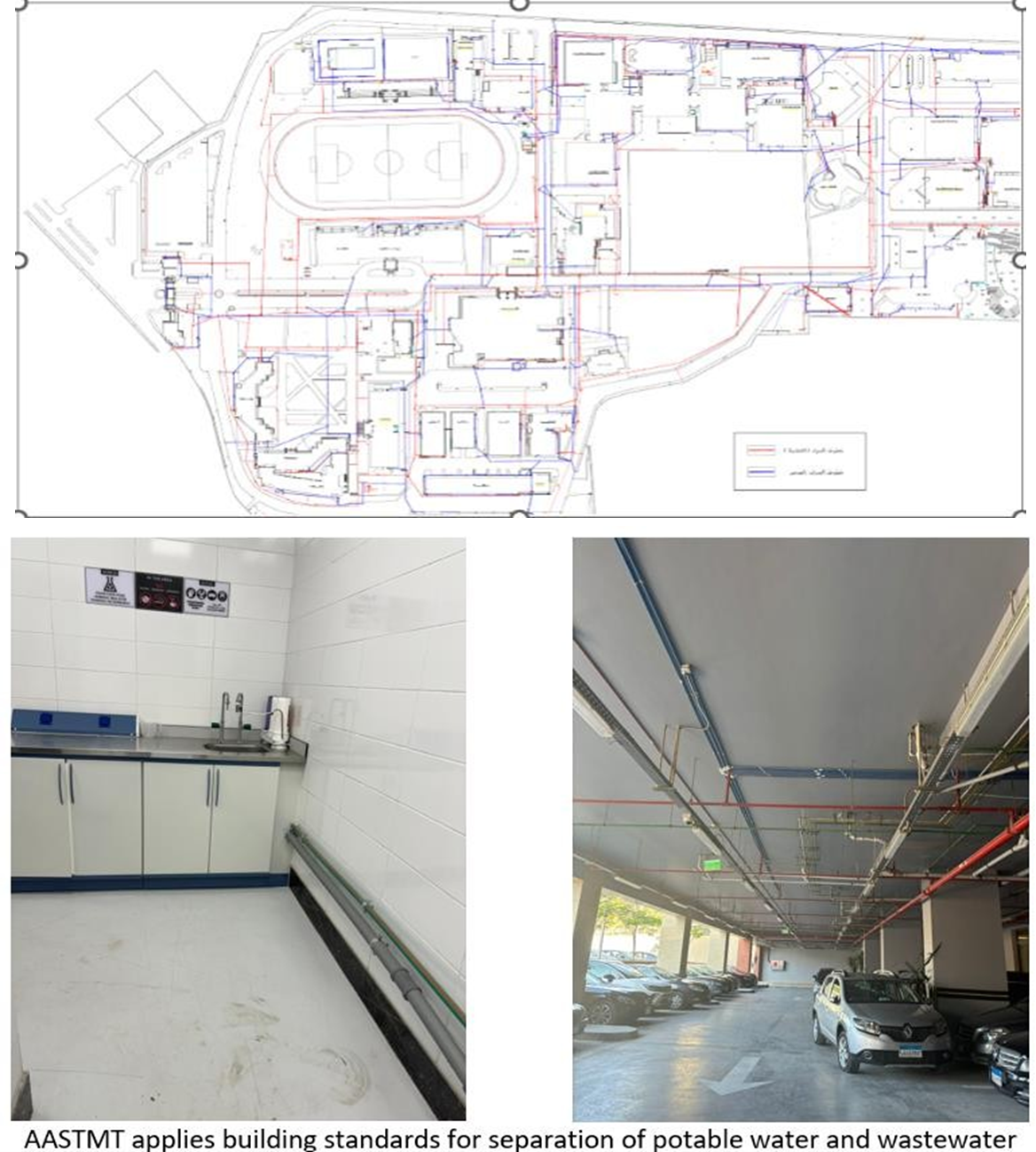
Dual Pipeline Systems: Distinct pipelines are used for potable water and wastewater across all facilities, preventing cross-contamination.
Backflow Prevention Devices: Installed and regularly maintained to prevent wastewater re-entering potable systems.
Routine Inspections and Audits: Regular inspections cover potable water pipes, wastewater lines, valves, sewage manholes, rain gutters, and building roofs.
Water Storage and Supply Safety:
Potable water is stored in separate tanks isolated from sewage lines, with designated monitoring systems to ensure supply safety.
Redundant Monitoring and Control:
Wastewater systems are equipped with backup control panels that prevent overflow or accidental discharge in case of failure. Visual plans and schematics at AASTMT illustrate potable (red) and wastewater (blue) pipelines, ensuring clarity and compliance. Laboratory systems also demonstrate color-coded separation (green for potable water, grey for drainage
AASTMT’s Wastewater treatment:
AASTMT’s wastewater management approach demonstrates full compliance with national environmental standards and guidelines, as all wastewater is directed to government-operated treatment facilities in accordance with Egyptian Standard No. 44 (2000) and Law No. 93 (1962). This ensures that all treated effluents meet the required discharge standards for environmental protection. By integrating these regulatory frameworks into its institutional sustainability policy, AASTMT reinforces its commitment to responsible wastewater management, environmental stewardship, and active contribution to SDG 6 (Clean Water and Sanitation) and SDG 13 (Climate Action).
Laboratory Waste Management Framework:
AASTMT implements a comprehensive hazardous waste disposal system to protect water quality from laboratory pollutants:
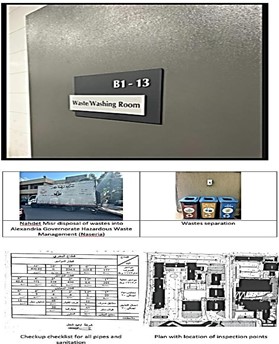
Waste Collection and Storage: Laboratory waste is segregated into chemical and biological waste streams and temporarily stored in controlled campus facilities.
Certified Disposal: Disposal is conducted twice weekly by Nahdet Misr, a certified company, under contracts adhering to Egyptian hazardous waste laws.
Safe Disposal Sites: Wastes are transferred to the Alexandria Governorate Hazardous Waste Management facility, ensuring safe treatment and disposal.
Regulatory Compliance: Laboratory waste management is governed by Egyptian legislation and aligned with
international biosafety protocols.
This system prevents harmful chemicals, biological agents, and pollutants from contaminating water sources.
AASTMT’s Environmental Standards and Certifications
AASTMT integrates its water discharge framework into broader environmental management standards, including:
- ISO 14001 Certification: Establishes a systematic framework for managing environmental responsibilities.
- Consumption and Recycling Policy: Reduces waste production and promotes sustainable use of resources.
- Life Policy and Water Usage Practices: Educates stakeholders on conserving water and minimizing pollution.
- Workshops and Training: AASTMT regularly organizes wastewater treatment workshops and awareness campaigns with students, staff, and local communities.
Awareness and Community Engagement
AASTMT reinforces its technical standards with awareness initiatives, funded projects, and stakeholder workshops:
- Wastewater Treatment Awareness: Campaigns and funded projects spread knowledge about the importance of safe wastewater management.
- Workshops with Stakeholders: Collaborative programs involve local communities, municipalities, and governmental authorities.
- Scientific Research and Innovation: AASTMT faculty and students contribute to research on wastewater treatment, green infrastructure, and sustainable campus operations.