At AAST, advancing gender inclusivity in higher education is an integral part of our mission. To support this goal, we have implemented a dedicated system that carefully tracks access and participation. A custom-built desktop application is used to monitor women’s application and admission rates across all academic programs. This system allows us to evaluate how effective our recruitment and admissions practices are, identify areas where gender bias may appear, and ensure that our processes remain transparent and fair. By continuously reviewing this information, we strengthen our commitment to providing equitable opportunities for women and fostering an environment where they can thrive academically.
This effort also reflects AAST’s broader dedication to diversity and student empowerment, particularly for groups that face additional barriers. A number of the women benefiting from these initiatives come from refugee communities—such as those from Syria and Palestine—highlighting how gender equity and social marginalization can intersect in complex ways.
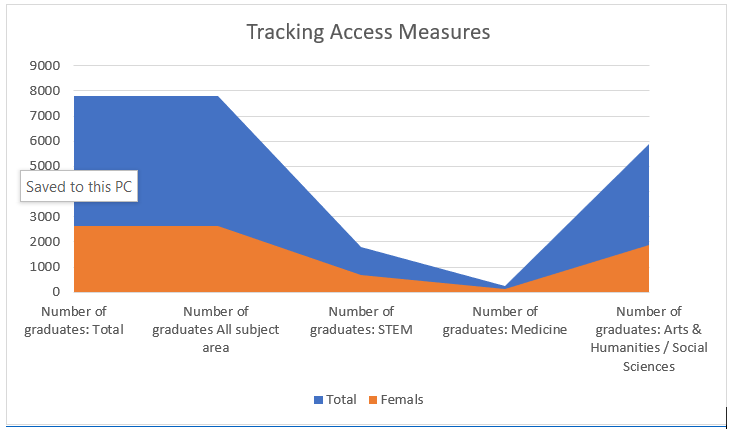
The charts below present the data on women’s access and graduation trends, comparing overall graduate numbers to female graduates, grouped by graduation type, for the academic years 2022/2023 and 2023/2024 at the undergraduate level.
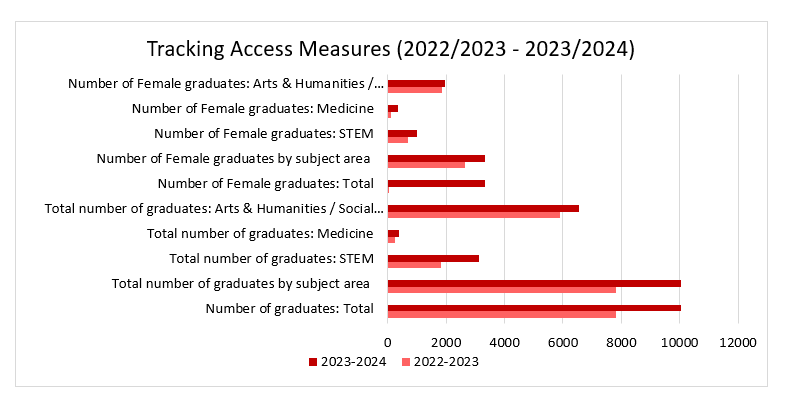
The chart visually confirms that growth in female graduation numbers aligns with, and in some subject areas outpaces, the overall rise in total graduates, illustrating expanding access opportunities for women. The figure Highlighted year-to-year changes, shifts in female representation across disciplines, and variations in overall graduation patterns:
At AAST, our commitment to promoting gender inclusivity in higher education is strengthened by a comprehensive system for tracking access measures. We have developed a sophisticated desktop application systematically tracks and monitors women's application and admission rates across academic programs. This technology allows us to assess the effectiveness of our outreach and admissions processes, addressing potential gender bias and ensuring transparency, accountability, and continuous improvement in fostering equal opportunities for female students. By leveraging this tool, we reinforce our dedication to creating a supportive and inclusive environment where every woman has equitable access to educational opportunities, regardless of gender.
This initiative aligns with AAST's broader mission to champion diversity and empower all students, particularly marginalized groups, in their academic pursuits. Many students who benefit from these efforts come from refugee backgrounds, including regions like Syria and Palestine, further emphasizing the intersection of marginalization and the challenges faced by women rights in education.
The figures below illustrate the tracking of access measures for graduate students compared to female graduates, categorized by graduation types for the 2021/2022 and 2022/2023 academic years for undergraduate students.

Within AAST, our commitment to promoting gender inclusivity in higher education is bolstered by our robust system for tracking access measures. At AAST, we already have a sophisticated desktop application dedicated to systematically measuring and monitoring women's application rates, as well as their acceptance or entry rates into academic programs. This tailored approach enables us to proactively assess the efficacy of our outreach and admission processes, ensuring transparency, accountability, and continuous improvement in fostering equal opportunities for women. By leveraging our existing technology, we demonstrate our dedication to providing a supportive and inclusive environment, where every woman has equitable access to educational opportunities. This initiative aligns with AAST's broader mission to champion diversity and empower all students in their academic pursuits.
The figure below shows tracking access measures for graduate students compared to females by graduation categories in the 2021/22 academic year for undergraduate students.