



 Goal 14. Life Below Water
14.4.2 Action Plan to Reduce Plastic Waste

2024-2025
- AASTMT Recycling Policy:
The Waste and Recycling Policy of AASTMT aligns with the University’s Environmental and Social Responsibility policies, aiming to reduce environmental impact through waste prevention, reuse, recycling, recovery, and proper disposal. It emphasizes minimizing waste, including single-use plastics, by encouraging staff and students to use reusable items and adopt sustainable practices. The policy considers life-cycle costs for new constructions and upgrades and promotes compliance with environmental laws and best practices. AASTMT has established comprehensive waste management and recycling systems that focus on reducing plastic waste in catering, events, and daily operations. Initiatives include replacing disposable plastics with compostable alternatives, providing reusable cups, and installing water stations to decrease bottled water waste. The policy also addresses hazardous waste management, ensuring it is handled safely to prevent harm to health and the environment. Overall, AASTMT remains committed to ongoing waste reduction efforts and adopting innovative solutions for sustainable waste management.
Scientific Research & Innovation-Alexandria | AASTMT
- Sustainability Achievements
AASTMT has recognized the harmful impact of plastic waste, from production to disposal. Plastic pollution greatly harms aquatic life, prompting the College to reduce plastic use and waste locally. Initiatives include replacing single-use plastics in dining services with compostable options across all food outlets and providing reusable cups to staff during onboarding to reduce disposable cup waste. Reusable cups are available for purchase at campus retail outlets, with discounts to encourage use and a small surcharge on disposables to promote a shift away from single-use cups. For conferences and events, reusable glassware is used to eliminate plastic waste from bottled water. Additionally, water stations have been installed around campus to promote bottle reuse and lessen reliance on packaged water. AASTMT remains committed to ongoing waste reduction by exploring new products and services that support decreased plastic consumption. The College has also implemented a waste segregation system with labeled bins across campuses, as demonstrated here at Abu-Qir. Campus.
Life Below Water-Alexandria | AASTMT
- The TouMaLi Research Project is a comprehensive, multi-year initiative scheduled to run from 2021 to 2025.
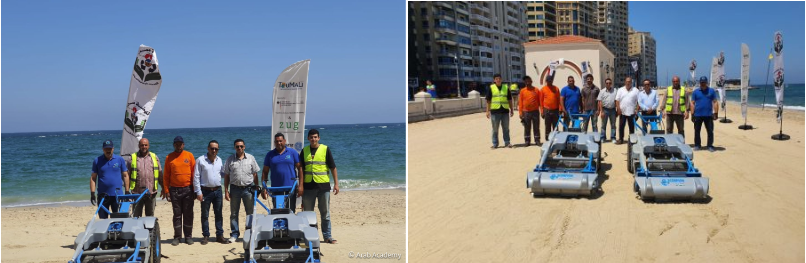
Reducing marine litter in Northern Africa—specifically in countries like Algeria, Egypt, Morocco, and Tunisia—is essential for protecting the region’s rich marine ecosystems. The strategy involves implementing sustainable waste management practices, promoting recycling, and encouraging reuse to minimize environmental impact. Key actions include coastal monitoring to track pollution levels, conducting comprehensive pollution assessments, and reviewing existing waste management systems to identify areas for improvement. It also involves implementing legal and technical solutions through close collaboration with local stakeholders, as well as capacity building programs and raising public awareness about marine conservation. In August 2021, a collaborative effort was initiated through the TouMaLi project, launched by the University of Rostock, the Leibniz Institute for Baltic Sea Research Warnemünde (IOW), the Arab Academy for Science, Technology, and Maritime Transport (AASTMT), and other partners. This project aims to combat tourism-related marine litter in Egypt, Morocco, Tunisia, and Algeria. Local partners include AASTMT and various Egyptian ministries, with approximately 4.2 million euros in funding from Germany's BMU, supported by ZUG gGmbH. Ultimately, this initiative is dedicated to advancing Sustainable Development Goal 14—life below water—by addressing the pressing issue of marine litter, especially plastics, to preserve ocean health for future generations.
Link 1: TouMaLi research project (2021-2025)
Link 2: TouMaLi research project (2021-2025)
Link 3: TouMaLi research project (2021-2025)
Link 4: TouMaLi research project (2021-2025)
https://toumali.org/en/partners
https://toumali.org/sites/toumali.org/files/documents/toumali_factsheet_eng.pdf
2023-2024
1.AASTMT Recycling Policy (Subject to Frequent Updates)
The Waste and Recycling Policy of AASTMT aligns with the University’s Environmental and Social Responsibility policies, aiming to reduce environmental impact through waste prevention, reuse, recycling, recovery, and proper disposal. It emphasizes minimizing waste, including single-use plastics, by encouraging reusable items and sustainable practices among staff and students. The policy considers life-cycle costs for new constructions and upgrades and promotes compliance with environmental laws and best practices. AASTMT has established comprehensive waste management and recycling systems, focusing on reducing plastic waste in catering, events, and daily operations. Initiatives include replacing disposable plastics with compostable alternatives, providing reusable cups, and installing water stations to decrease bottled water waste. The policy also addresses hazardous waste management, ensuring it is handled safely to prevent harm to health and the environment. Overall, AASTMT remains committed to ongoing waste reduction efforts and adopting innovative solutions for sustainable waste management.
2.Sustainability Achievements
AASTMT has recognized the harmful impact of plastic waste, from production to disposal. Plastic pollution greatly harms aquatic life, prompting the College to cut down on plastic use and waste locally. Initiatives include replacing single-use plastics in dining services with compostable options across all food outlets and providing reusable cups to staff during onboarding to reduce disposable cup waste. Reusable cups are available for purchase at campus retail outlets, with discounts to encourage their use, promoting a shift from single-use cups through a small surcharge for disposables. For conferences and events, reusable glassware is used to eliminate plastic waste from bottled water. Additionally, water stations have been installed around campus to promote bottle reuse and lessen reliance on packaged water. AASTMT remains committed to ongoing waste reduction by exploring new products and services that support decreased plastic consumption. The College has also put in place a waste segregation system with labeled bins across campuses, as demonstrated here at Abu-Qir. Campus.
2022-2023
AASTMT Recycling Policy
This Waste and recycling policy shapes part of the AAST''s manageability structure and helps uphold the University''s Environmental Change and Social Duty Policy:
The policy's point is to lessen negative natural effects emerging from our age of waste raising, looking to forestall, reuse, repurpose, and decrease squandering from our activity. The Policy likewise plans to guarantee that AASTMT oversees squander issues as per the counteraction of contamination and consistent with natural enactment.
AASTMT has a vigorous and complete reusing foundation, and all staff and understudies are urged to utilize these offices to help reuse as much waste with no guarantees conceivable.
Policy
AASTMT’s committed Policy likewise incorporates the need to think about finish-of-life removal costs and natural effects when settling on acquirement choices including the development of new or revamped structures.
AASTMT receives the ''waste order'' of Prevention, reuse, reusing, other recuperation, and removal. AASTMT executes cycles, methods, and activities that guarantee consistency with ecological enactment and best practice, and which urge policymakers to lessen the general waste that t produced and forestall waste creation at every possible opportunity.
AASTMT has a powerful and complete reusing foundation, and all staff and understudies are urged to utilize these offices to help reuse as much waste as is conceivable.
The Waste Progressive System and Stages Incorporates:
- Prevention: Utilizing less material in plan-keeping items for more utilizing less unsafe material.
- RE-USE: Getting ready for re-use cleaning fixing and restoring.
- Recycle: Transforming waste into another substance or item, including fertilizing the soil.
- Recovery: Anaerobic assimilation & ndash transformation to biogas for power age burning with energy recuperation.
- Disposal: Landfill and cremation without energy recuperation.
The policy additionally guarantees that we are conforming to guidelines, enactment, and best practices to limit the danger of prompt and future contamination or mischief to well-being when completing operational exercises.
Target - Explicitly, this policy requires that by 2022 AASTMT has halted the utilization of ''single-use'' plastics nearby utilizing a blend of elective materials and the suspension of deals of plastic filtered water nearby. AASTMT is additionally introducing serious drinking fountains to assist with this particular point.
Plastic Waste Decrease
AASTMT perceives the unfavorable effect of plastic waste, from creation through to removal. Plastic contamination can destructively affect the marine climate and the College is looking to diminish plastic use and wastage nearby. The accompanying activities have been received to advance this point with staff and understudies:
- Single-use plastics in catering (food bundling, dispensable coffee cups, cutlery) have been supplanted with compostable catering supplies in all College food outlets, to lessen plastic waste nearby.
- Reusable cups are given to AASTMT staff during staff acceptances to decrease single-utilize dispensable cup wastage. These can likewise be bought from grounds retail outlets and limits are offered to clients when reusable cups are used. Single use cups cause an extra charge to urge a transition to reusable cups.
- Conferencing and Occasions use reusable crystal to serve water, killing waste from recently used plastic filtered water. The group additionally produce cleaned water nearby, diminishing waste further by evading the need to purchase water in dispensable bundling. Water stations have been introduced all through the grounds for use by understudies and staff to support bottle reuse.
AASTMT intends to keep on diminishing waste by investigating new items and administrations which will help with accomplishing decreased plastics utilization and waste.
Waste Management
AASTMT has set up various inside and outer waste administration and reusing offices.
Consistence
Resources and Expert Administrations, Understudies, Workers for hire and different clients are needed to have fitting methods and waste administration measures set up as pertinent to guarantee that waste created is overseen, put away and discarded securely and in accordance with the AASTMT''s approaches.
Waste Move Notes should be gotten by the Staff or Expert Administrations Office when utilizing an outside endorsed specialist organization/project worker to discard squander.
Waste minimization
Waste ought to be forestalled or limited at every possible opportunity. AASTMT empowers staff, and understudies to limit plastic waste however much as could reasonably be expected by utilizing reusable jugs or glasses for drinking water.
Dangerous Waste
Definition
Perilous Waste will be squandered which can be hurtful to the well-being of the climate. It incorporates irresistible organic/clinical waste, synthetics, solvents, pesticides, glaring light cylinders, refrigeration hardware containing ozone, non-eatable oils, batteries, asbestos, and paints.
Arrangement Explanation
The College will oversee, so far as is sensibly practicable, all dangerous waste exercises falling under its influence in a way, for example, to limit the mischief to human wellbeing or the climate.
AASTMT Recycling Policy on AASTMT webpage
Sustainability Accomplishments
AASTMT perceives the unfavorable effect of plastic waste, from creation through to removal. Plastic contamination can destructively affect Aquatic life, and the College is looking to diminish plastic use and wastage nearby. The accompanying activities have been received to advance this point with staff and understudies:
Single-use plastics in catering (food bundling, dispensable coffee cups, cutlery) have been supplanted with compostable catering supplies in all College food outlets to lessen plastic waste nearby.
Reusable cups are given to AASTMT staff during staff acceptances to decrease single-utilize dispensable cup wastage. These can likewise be bought from grounds retail outlets, and limits are offered to clients when reusable cups are used. Single-use cups cause an extra charge to urge a transition to reusable cups.
Conferencing and Occasions use reusable crystals to serve water, killing waste from recently used plastic-filtered water. The group additionally produces cleaned water nearby, diminishing waste further by evading the need to purchase indispensable water bundling. To support bottle reuse, water stations have been introduced all through the grounds for use by understudies and staff.
AASTMT intends to keep on diminishing waste by investigating new items and administrations that will help accomplish decreased plastic utilization and waste. To achieve the aforementioned AASTMT adopted a garbage segregation strategy and has distributed categorized trash bins in all its campuses the following pictures are from the Abu-Qir Campus.
