2024–2025
AASTMT Anti-Discrimination Policy on AASTMT webpage
Institutional Anti-Discrimination Policy and Equality, Diversity and Inclusion Framework
The Arab Academy for Science, Technology and Maritime Transport (AASTMT) demonstrates its institutional commitment to social justice, social inclusion, equal opportunity, and non-discrimination through its formal Anti-Discrimination Policy and Equality, Diversity and Inclusion (EDI) Policy. These policies establish an institutional framework for preventing discrimination, promoting equitable treatment, and addressing social inequality across the Academy's educational and working environments.
The policies aim to safeguard the rights of students, faculty members, staff, and applicants, irrespective of age, gender, disability, nationality, religion, socioeconomic background, or other protected characteristics. They reinforce AASTMT's commitment to an inclusive and non-discriminatory academic environment, ensuring that individuals from disadvantaged and underrepresented groups are treated fairly and have equitable opportunities to participate in education and employment.
AASTMT's institutional framework also provides mechanisms for addressing discriminatory practices, including reporting concerns, reviewing complaints, and implementing appropriate corrective measures. These provisions contribute to reducing structural barriers, strengthening social integration, and promoting equal opportunities and upward social mobility.
The Academy's Anti-Discrimination Policy, documented as reviewed in November 2024, provides particularly relevant evidence of its institutional commitment to reducing inequalities during Academic Year 2024–2025.
Non-discrimination Policy
Description
The Arab Academy for Science, Technology, and Maritime Transport (AASTMT) is committed to creating an environment of mutual respect and dignity for all its members. Everyone has the right to work in an atmosphere that promotes equal opportunities and prohibits unlawful discrimination. AASTMT firmly asserts its dedication to ensuring that no student, staff member, or visitor experiences discrimination based on age, disability, gender, marital status, pregnancy or maternity, race, religion or belief, sex, socio-economic background, or trade union membership. Additionally, the Academy actively opposes any assumptions or expectations about students or staff based on stereotypes, ensuring that diverse cultural, religious, and academic perspectives are adequately represented in the AASTMT learning and working environment.
Consequently, the Arab Academy for Science, Technology, and Maritime Transport expects that all interactions among its members and stakeholders will be formal, professional, and free from explicit bias, prejudice, and discrimination.
Scope
This policy applies to all staff, students, employees, and applicants associated with the Academy, regardless of whether the misconduct was perpetrated by coworkers or by individuals not directly affiliated with the Arab Academy for Science, Technology, and Maritime Transport (e.g., outside vendors, consultants, or customers).
Aims of the Policy
The Arab Academy for Science, Technology, and Maritime Transport has implemented this policy to guarantee that all staff, students, employees, and applicants operate in an environment free from unlawful discrimination. The Academy makes every reasonable effort to ensure that all individuals are informed about these policies and understand that any complaint alleging a violation will be investigated and addressed appropriately.
Definitions
Discrimination
The principle of non-discrimination assumes an environment where everyone can fully participate and realize their potential. This also necessitates that individuals are free to express their opinions without undue limitations.
Discrimination based on any other protected characteristic is equally unlawful. In this policy, discrimination is defined as verbal, written, or physical behavior that disparages or shows hostility or aversion toward any individual based on their race, color, religion, sex, sexual orientation, gender identity or expression, national origin, age, disability, marital status, citizenship, genetic information, or any other protected characteristic, as well as that of their relatives, friends, or associates. Such conduct may: a) have the purpose or effect of creating a hostile learning or work environment.
This conduct includes epithets, slurs, negative stereotyping, threatening, intimidating, or hostile actions, and written or graphic materials that disparage or demonstrate hostility or aversion toward an individual or group. This includes content posted on walls, distributed on AASTMT’s various social media channels, or sent via email, phone (including voice messages), text messages, or other means.
In this regard, all individuals must be treated equally, and all forms of:
Equal opportunity
The policy of the Arab Academy for Science, Technology, and Maritime Transport is to guarantee equal educational and employment opportunities without regard to race, color, religion, sex, sexual orientation, gender identity or expression, age, disability, marital status, citizenship, national origin, genetic information, or any other legally protected characteristic. Discrimination of any kind is not tolerated at the Arab Academy for Science, Technology, and Maritime Transport.
Retaliation
The Arab Academy for Science, Technology, and Maritime Transport encourages the reporting of all perceived incidents of discrimination. It is the Academy's policy to investigate these reports promptly and thoroughly. Additionally, the Arab Academy for Science, Technology, and Maritime Transport prohibits retaliation against anyone who reports discrimination or participates in an investigation related to such reports.
Policy Statement
Our policies must not be used to exclude or separate individuals based on their gender identity or any other protected characteristic from learning, training, business, or social activities involving students or staff, as well as discussions. In other words, no one should mistakenly use discrimination or exclusion as a means to avoid accountability. The statutes and regulations of the Arab Academy for Science, Technology, and Maritime Transport prohibit discrimination based on sex or any other protected characteristic in terms, conditions, privileges, and benefits of education and employment. The prohibitions against discrimination and retaliation are intended to complement and reinforce these regulations, not to provide a basis for exemption.
Procedures
Reporting an Incident of Discrimination or Retaliation
The Arab Academy for Science, Technology, and Maritime Transport strongly encourages reporting any perceived instances of discrimination or retaliation, regardless of the offender's name or position:
For students:
Please refer to the complaint procedures outlined below.
Additionally, the Arab Academy for Science, Technology, and Maritime Transport advises individuals who believe they are experiencing such conduct to notify the perpetrator immediately and request that the behavior stop. Often, this action is sufficient to resolve the issue. However, the Academy understands that an individual may prefer to address the matter through formal complaint procedures.
Please refer to the complaint methods outlined below.
Complaint Procedures
Individuals who believe they have been victims of, or have witnessed, activities prohibited by this policy should express their concerns to their immediate student affairs department representative, the college vice dean for student affairs, their supervisor, human resources, any member of the personnel practices committee, or an ombudsman.
The Arab Academy for Science, Technology, and Maritime Transport encourages early reporting of complaints or concerns to facilitate swift and constructive action before relationships become irreparably strained. Consequently, while there is no specific reporting timeframe, early reporting and intervention are the most effective means of resolving actual or perceived instances of discrimination.
Allegations of discrimination or retaliation will be investigated promptly. The investigation may include individual interviews with the involved parties and, as appropriate, with individuals who may have witnessed the alleged conduct or have relevant information.
The Arab Academy for Science, Technology, and Maritime Transport will maintain confidentiality throughout the investigation, to the extent necessary for a thorough inquiry and appropriate corrective action.
Retaliation against any individual for reporting discrimination or for cooperating with an inquiry into allegations of harassment or discrimination is a serious violation of this policy. Like discrimination, it will lead to disciplinary action. Retaliatory actions should be reported immediately and will be addressed promptly. All instances of discrimination and retaliation will be handled accordingly.
Responsive action may include but is not limited to:
For students: Possible actions include training and counseling, verbal or written warnings, temporary college suspension, or expulsion.
For staff members or employees: Potential measures include training, referral to counseling, or disciplinary actions such as warnings, reprimands, withholding promotions or pay raises, reassignment, temporary suspension without pay, or termination, as deemed appropriate by the Arab Academy for Science, Technology, and Maritime Transport.
Review program
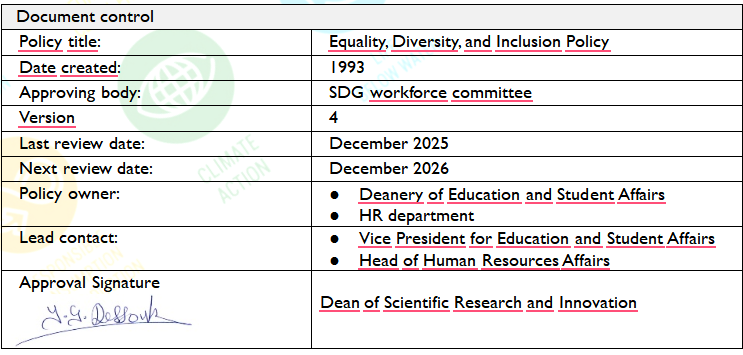
EQUALITY, DIVERSITY, AND INCLUSION POLICY
Introduction
The Arab Academy for Science, Technology, and Maritime Transport (AASTMT), as a member of the Arab League, is dedicated to aligning its labor policies and practices with the principles outlined in the UN Declaration of Human Rights. In accordance with Egyptian law and international mandates, AASTMT has established a strong legal framework to protect individuals, especially women, from discrimination, harassment, and victimization in both the workplace and society. Our admission policy aims to create a learning, working, and social environment that is entirely free from discrimination, prejudice, intimidation, stigmatization, and all forms of harassment and bullying. AASTMT firmly commits to ensuring that no student, staff member, or visitor, particularly women, experiences discrimination based on age, disability, immigration status, gender, marital status, pregnancy or maternity, race, religion or belief, sex, socio-economic status, or trade union affiliation. Additionally, the institution actively prohibits stereotypes that may lead to assumptions about students, ensuring diverse cultural, religious, and academic perspectives are represented in educational materials. AASTMT promotes a culturally inclusive learning environment that addresses the diverse needs of learners, including women, regarding gender, ethnicity, religion, disability, immigration status, and age through varied teaching methods, language support, and a steadfast commitment to inclusivity.
Scope
Policy Statement
AASTMT is dedicated to promoting social justice and fostering an environment where every member of our community, including women, is treated with respect and dignity. We are committed to employing a diverse workforce and educating a student body that reflects the global community we serve, including individuals from Europe, Asia, North America, and the Gulf region. Our institution prioritizes equal opportunity and strives to ensure that all staff, students, and visitors are treated fairly, free from discrimination based on age, disability, gender, marital status, pregnancy, race (including color, nationality, and ethnic origins), and religion. We recognize the importance of addressing health disparities and social inequalities, particularly in relation to students with autism, marginalized groups, and migrant workers.
AASTMT aims to create pathways for social mobility and inclusion, ensuring that all students, including women, can register for courses through an application process that considers the needs of diverse learners regarding gender, immigration status, race, religion, disability, age, and socioeconomic status. We aspire not only to be a source of employment but also to provide opportunities for groundbreaking innovation, forming dynamic teams that address gender issues and are tailored to meet the diverse needs of our staff. Our commitment to financial stability and effective retention practices, alongside robust human resources policies, supports career growth and comprehensive benefits programs.
Recognizing the critical role of our faculty and staff in achieving institutional success across research, training, teaching, and consultancy services, we understand that attracting highly qualified individuals is essential. Our esteemed reputation as a world-class educational institution is built on this commitment, but the sustainability of AASTMT depends on our ability to address economic inequality, health inequities, gender bias, and the effects of financial crises on our community.
Considering current migration flows and the challenges posed by international migration, we stand firm against sexism, racial discrimination, and social stratification, advocating for policies that promote integration and justice for all, including asylum seekers and undocumented migrants. AASTMT is committed to fostering an inclusive environment that champions health equity and addresses the disparities faced by marginalized groups, ensuring that everyone can thrive.
Roles and Responsibilities
The AASTMT Board of Trustees holds ultimate accountability for ensuring compliance with the institution's obligations regarding equality and social justice, particularly concerning gender issues and the status of women. It is essential for both staff and students, including women, to familiarize themselves with and understand this policy. Their responsibilities include challenging and reporting unacceptable behaviour, such as aggression, sexism, and gender bias, through secure mechanisms and the established grievance procedures.
Deans, managers, and advisors play a vital role in modelling positive behaviour by treating all AASTMT members, especially marginalized groups, with dignity and respect while actively addressing any instances of discrimination or harassment. Their duties also involve ensuring that all staff and students are well-informed about this policy and understand the processes for reporting discrimination, harassment, or bullying, including risks related to hypersexuality and sexual risk, without fear of retaliation.
Furthermore, these leaders are responsible for providing staff with information about their rights as outlined in AASTMT policies, including those related to maternity and paternity, as well as broader employee rights. This commitment to inclusion and equity is crucial in fostering an environment where all individuals, regardless of gender, can thrive without facing social inequalities or health disparities.
Aims of the Policy
AASTMT aims to promote equality of opportunity for all, through the following objectives:
Implementation
Human Resources Practices:
Special practices for students with disabilities:
Sanctions
Non-compliance with the principles outlined in this policy may be deemed a disciplinary offense and will be addressed through the appropriate procedures
Complaints
AASTMT is dedicated to addressing any incidents of discrimination, harassment, bullying, or victimization with the highest level of seriousness. If a staff or student member is found guilty of unlawful discrimination, sexism, or harassment, appropriate disciplinary measures will be implemented. This commitment also applies to members of the public, visitors, or service providers who engage in discriminatory behavior or exhibit aggression, especially against women or other marginalized groups. Individuals who file discrimination complaints, including staff, students, or others, have the right to do so without fear of retaliation, and the institution guarantees that all complaints, including those concerning gender bias or gender issues, will be handled promptly and fairly. Members of the public are encouraged to initially direct their complaints to the appropriate University service, and AASTMT permits the submission of informal complaints either anonymously or with assistance from an advisor, ensuring a safe space for addressing concerns, particularly related to the status of women.
Internal Monitoring and Auditing
Monitoring will take place through the Annual Performance Review (APR) process. The diversity of job applicants, shortlisted candidates, new appointments, academic promotions, student admissions, and attainment, will be monitored as part of the annual reporting.
Further Information
Further information and support are available from the following:
Paternity, partner and adoption support policy:
Purpose: This policy sets out Arab Academy for Science, Technology and Maritime Transport (AASTMT) provisions for paternity and partner leave, adoption- and surrogacy-related leave, flexible working, and associated benefits. It aligns with AASTMT’s Equality, Diversity and Inclusion commitments and applies to all staff regardless of contract type, working pattern, or gender identity, including adoptive and intended parents.
Scope: The policy covers leave and support for: (a) a staff member who is a father, non‑birth mother, or partner (including same‑sex partner) of the birth parent; (b) an adoptive parent or partner; and (c) an intended parent via surrogacy. It also provides time off to attend qualifying appointments and sets job protection, pay, and notice rules. Nothing in this policy reduces rights granted under applicable Egyptian law or AASTMT contracts; where law or contract is more generous, the more generous provision prevails.
1. Eligibility
Employed by AASTMT at the expected week of childbirth (EWC), child placement, or parental order application.
• Employed by AASTMT at the expected week of childbirth (EWC), child placement, or parental order application.
Be the child’s father, the birth parent’s spouse/partner, an adoptive parent or partner, or an intended parent in a surrogacy arrangement.
• Be the child’s father, the birth parent’s spouse/partner, an adoptive parent or partner, or an intended parent in a surrogacy arrangement.
Provide the required notice and evidence (see section 6).
• Provide the required notice and evidence (see section 6).
2. Leave and pay entitlements
AASTMT provides the following minimum entitlements. Colleges/units may offer more generous terms with HR approval.
Paid paternity/partner leave: up to 10 working days on full pay, to be taken in one or two blocks within 8 weeks of birth or placement.
• Paid paternity/partner leave: up to 10 working days on full pay, to be taken in one or two blocks within 8 weeks of birth or placement.
Additional parental leave: up to 10 further working days unpaid (or taken as annual leave subject to manager approval) within 6 months of birth or placement.
• Additional parental leave: up to 10 further working days unpaid (or taken as annual leave subject to manager approval) within 6 months of birth or placement.
Multiple births/adoptions: the same entitlements apply per event.
• Multiple births/adoptions: the same entitlements apply per event.
Premature birth/NICU: paid leave window may be deferred to commence from the child’s hospital discharge, upon HR approval.
• Premature birth/NICU: paid leave window may be deferred to commence from the child’s hospital discharge, upon HR approval.
Bereavement, miscarriage or stillbirth (from 24 weeks’ gestation): up to 10 working days paid compassionate leave in addition to any statutory entitlements.
• Bereavement, miscarriage or stillbirth (from 24 weeks’ gestation): up to 10 working days paid compassionate leave in addition to any statutory entitlements.
3. Time off for antenatal/adoption appointments
Eligible staff may take paid time off to attend up to two antenatal or pre‑adoption appointments (up to 6 hours per appointment, including reasonable travel). Evidence of appointment time may be requested by HR.
4. Flexible working and workplace adjustments
Temporary flexible arrangements (e.g., adjusted hours, remote/hybrid working, compressed weeks) may be agreed for up to 12 weeks post‑return; extensions require HR review.
• Temporary flexible arrangements (e.g., adjusted hours, remote/hybrid working, compressed weeks) may be agreed for up to 12 weeks post‑return; extensions require HR review.
Reasonable adjustments include schedule changes around childcare pick‑up, medical appointments, and bonding needs, balanced with operational requirements.
• Reasonable adjustments include schedule changes around childcare pick‑up, medical appointments, and bonding needs, balanced with operational requirements.
Annual leave may be combined with paternity/partner leave subject to normal approval routes.
• Annual leave may be combined with paternity/partner leave subject to normal approval routes.
5. Job protection, benefits and non‑discrimination
Continuous service, pay progression, and benefits (including pension and allowances) continue during paid leave.
• Continuous service, pay progression, and benefits (including pension and allowances) continue during paid leave.
Return to the same role or, where not reasonably practicable, a suitable alternative on no less favourable terms.
• Return to the same role or, where not reasonably practicable, a suitable alternative on no less favourable terms.
No detriment, discrimination or harassment for taking or requesting leave, flexible working, or adjustments. Breaches are subject to disciplinary action.
• No detriment, discrimination or harassment for taking or requesting leave, flexible working, or adjustments. Breaches are subject to disciplinary action.
6. Notice and evidence requirements
Staff should notify their line manager and HR in writing at least 15 weeks before the expected week of childbirth (or as soon as reasonably practicable for adoption/surrogacy), stating: (a) the expected date of birth/placement; (b) intended leave start date and duration; and (c) confirmation of eligibility. HR may request evidence such as a medical note/appointment card, adoption matching certificate, or surrogacy documentation.
7. Coordination with statutory/contractual pay
AASTMT paid leave will be coordinated with any statutory or contractual entitlements. Where statutory entitlements arise, AASTMT pay will be inclusive so that total pay does not exceed normal full pay unless otherwise agreed.
8. Related policies and support
Maternity and pregnancy loss support; adoption and surrogacy; parental bereavement; flexible working; dignity and respect at work; grievance.
• Maternity and pregnancy loss support; adoption and surrogacy; parental bereavement; flexible working; dignity and respect at work; grievance.
Childcare: staff may use approved local nursery arrangements and, for Smart Village campus, facilities available within the business park (see campus pages and Smart Village Club services).
• Childcare: staff may use approved local nursery arrangements and, for Smart Village campus, facilities available within the business park (see campus pages and Smart Village Club services).
Wellbeing and counselling: Psychological Support Services and the Employee Assistance channels.
• Wellbeing and counselling: Psychological Support Services and the Employee Assistance channels.
9. Governance, review and queries
Human Resources is the owner of this policy. Colleges/units are responsible for local communication and implementation. The policy will be reviewed annually and after material legislative change. Queries should be directed to HR.

AASTMT institutionalizes equal opportunity, non-discrimination and social justice through a formal Equality, Diversity and Inclusion policy that explicitly protects students and staff from discrimination by age, gender, disability, nationality, religion, socio-economic status and other characteristics. This policy provides the legal and operational foundation for tracking access, supporting integration of under-represented groups, and working to reduce educational disparities—a continuous institutional measure that underpins efforts to increase the proportion of graduates from disadvantaged backgrounds"
AASTMT Anti-Discrimination Policy
EQUALITY, DIVERSITY, AND INCLUSION POLICY - Quality Education
AASTMT’s Disability Accommodation Policy and the Accessibility Center deliver practical disability support services—including assistive technologies, counselling, and academic adjustments—helping remove barriers to completion for students with disabilities. These sustained measures promote health equity, academic inclusion, and upward mobility for a historically under-represented group, strengthening the pathway from enrolment to graduation. (SDG pages record services for 2022–2023 and the Accessibility Center remains active into 2023–24.)
Disability Policy - Environmental, Social and Governance
Independent and institutional reporting shows AASTMT’s Alexandria campus meets a high proportion of accessibility criteria for students with special needs (an 80%-level finding in campus accessibility evaluation). This measurable progress in facility accessibility and accommodations demonstrates concrete, continuous efforts to remove physical and pedagogic barriers—thereby supporting higher completion rates among students with disabilities and aligning with 10.6.4’s objective to raise graduation proportions for disadvantaged groups.
AASTMT’s Non-Discrimination Policy reinforces legal protections against victimization, harassment, and discrimination, in line with Egyptian legislation and international directives. AASTMT is committed to fostering an inclusive and culturally diverse environment, combating stereotypes, and ensuring equal opportunities for all through its dedication to non-discrimination and diversity
The Arab Academy for Science, Technology, and Maritime Transport (AASTMT) is committed to creating an environment of mutual respect and dignity for all its members. Everyone has the right to work in an atmosphere that promotes equal opportunities and prohibits unlawful discrimination. AASTMT firmly asserts its dedication to ensuring that no student, staff member, or visitor experiences discrimination based on age, disability, gender, marital status, pregnancy or maternity, race, religion or belief, sex, socio-economic background, or trade union membership. Additionally, the Academy actively opposes any assumptions or expectations about students or staff based on stereotypes, ensuring that diverse cultural, religious, and academic perspectives are adequately represented in the AASTMT learning and working environment.
Consequently, the Arab Academy for Science, Technology, and Maritime Transport expects that all interactions among its members and stakeholders will be formal, professional, and free from explicit bias, prejudice, and discrimination.
Scope
This policy applies to all staff, students, employees, and applicants associated with the Academy, regardless of whether the misconduct was perpetrated by coworkers or by individuals not directly affiliated with the Arab Academy for Science, Technology, and Maritime Transport (e.g., outside vendors, consultants, or customers).
The behaviors prohibited by this policy are deemed inappropriate both on and off AASTMT campuses, including classrooms, laboratories, dormitories, offices, or any educational or work-related environments. This also extends to activities outside the campuses, such as during student or business trips, meetings, and social events related to students or business.
This policy is non-contractual and may be revised at any time.
The Arab Academy for Science, Technology, and Maritime Transport has implemented this policy to guarantee that all staff, students, employees, and applicants operate in an environment free from unlawful discrimination. The Academy makes every reasonable effort to ensure that all individuals are informed about these policies and understand that any complaint alleging a violation will be investigated and addressed appropriately.
Definitions
Discrimination
The principle of non-discrimination assumes an environment where everyone can fully participate and realize their potential. This also necessitates that individuals are free to express their opinions without undue limitations.
Discrimination based on any other protected characteristic is equally unlawful. In this policy, discrimination is defined as verbal, written, or physical behavior that disparages or shows hostility or aversion toward any individual based on their race, color, religion, sex, sexual orientation, gender identity or expression, national origin, age, disability, marital status, citizenship, genetic information, or any other protected characteristic, as well as that of their relatives, friends, or associates. Such conduct may: a) have the purpose or effect of creating a hostile learning or work environment.
This conduct includes epithets, slurs, negative stereotyping, threatening, intimidating, or hostile actions, and written or graphic materials that disparage or demonstrate hostility or aversion toward an individual or group. This includes content posted on walls, distributed on AASTMT’s various social media channels, or sent via email, phone (including voice messages), text messages, or other means.
In this regard, all individuals must be treated equally, and all forms of:
The policy of the Arab Academy for Science, Technology, and Maritime Transport is to guarantee equal educational and employment opportunities without regard to race, color, religion, sex, sexual orientation, gender identity or expression, age, disability, marital status, citizenship, national origin, genetic information, or any other legally protected characteristic. Discrimination of any kind is not tolerated at the Arab Academy for Science, Technology, and Maritime Transport.
Retaliation
The Arab Academy for Science, Technology, and Maritime Transport encourages the reporting of all perceived incidents of discrimination. It is the Academy's policy to investigate these reports promptly and thoroughly. Additionally, the Arab Academy for Science, Technology, and Maritime Transport prohibits retaliation against anyone who reports discrimination or participates in an investigation related to such reports.
Policy Statement
Our policies must not be used to exclude or separate individuals based on their gender identity or any other protected characteristic from learning, training, business, or social activities involving students or staff, as well as discussions. In other words, no one should mistakenly use discrimination or exclusion as a means to avoid accountability. The statutes and regulations of the Arab Academy for Science, Technology, and Maritime Transport prohibit discrimination based on sex or any other protected characteristic in terms, conditions, privileges, and benefits of education and employment. The prohibitions against discrimination and retaliation are intended to complement and reinforce these regulations, not to provide a basis for exemption.
Procedures
Reporting an Incident of Discrimination or Retaliation
The Arab Academy for Science, Technology, and Maritime Transport strongly encourages reporting any perceived instances of discrimination or retaliation, regardless of the offender's name or position:
For students:
Please refer to the complaint procedures outlined below.
Additionally, the Arab Academy for Science, Technology, and Maritime Transport advises individuals who believe they are experiencing such conduct to notify the perpetrator immediately and request that the behavior stop. Often, this action is sufficient to resolve the issue. However, the Academy understands that an individual may prefer to address the matter through formal complaint procedures.
Please refer to the complaint methods outlined below.
Complaint Procedures
Individuals who believe they have been victims of, or have witnessed, activities prohibited by this policy should express their concerns to their immediate student affairs department representative, the college vice dean for student affairs, their supervisor, human resources, any member of the personnel practices committee, or an ombudsman.
The Arab Academy for Science, Technology, and Maritime Transport encourages early reporting of complaints or concerns to facilitate swift and constructive action before relationships become irreparably strained. Consequently, while there is no specific reporting timeframe, early reporting and intervention are the most effective means of resolving actual or perceived instances of discrimination.
Allegations of discrimination or retaliation will be investigated promptly. The investigation may include individual interviews with the parties involved and, as appropriate, with individuals who may have witnessed the alleged conduct or have relevant information.
The Arab Academy for Science, Technology, and Maritime Transport will maintain confidentiality throughout the investigation, to the extent necessary for a thorough inquiry and appropriate corrective action.
Retaliation against any individual for reporting discrimination or for cooperating with an inquiry into allegations of harassment or discrimination is a serious violation of this policy. Like discrimination, it will lead to disciplinary action. Retaliatory actions should be reported immediately and will be addressed promptly. All instances of discrimination and retaliation will be handled accordingly.
Responsive action may include but is not limited to:
For students: Possible actions include training and counseling, verbal or written warnings, temporary college suspension, or expulsion.
For staff members or employees: Potential measures include training, referral to counseling, or disciplinary actions such as warnings, reprimands, withholding promotions or pay raises, reassignment, temporary suspension without pay, or termination, as deemed appropriate by the Arab Academy for Science, Technology, and Maritime Transport.
Review program
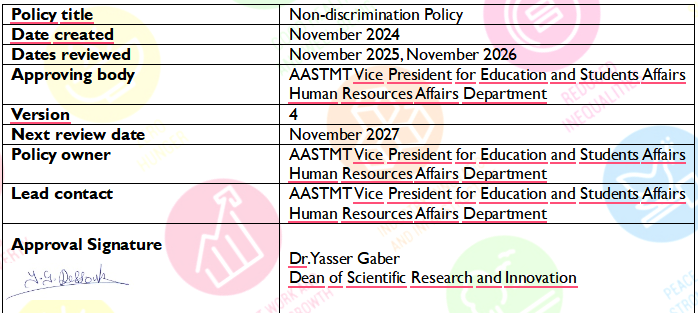
Policy title | Non-discrimination Policy |
Date created | November 2024 |
Dates reviewed | November 2024 |
Approving body | AASTMT Vice President for Education and Students Affairs Human Resources Affairs Department |
Version | 2 |
Next review date | November 2025 |
Policy owner | AASTMT Vice President for Education and Students Affairs Human Resources Affairs Department |
Lead contact | AASTMT Vice President for Education and Students Affairs Human Resources Affairs Department |
Approval Signature | Dr. Yasser Gaber Dean of Scientific Research and Innovation |
↵
The Arab Academy for Science, Technology, and Maritime Transport (AASTMT), an entity within the Arab League, aligns its labor policies with the UN Declaration of Human Rights. Following Egyptian law and international mandates, AASTMT establishes a robust legal framework against discrimination, harassment, and victimization. The admission policy aims for a discrimination-free environment, asserting AASTMT's commitment to non-discrimination based on various factors. The institution actively opposes stereotypes, ensuring diverse perspectives in learning materials and fostering a culturally inclusive environment through multi-mode teaching methods and unwavering inclusivity commitment.
EQUALITY, DIVERSITY, AND INCLUSION POLICY on the AASTMT webage
Read our EQUALITY, DIVERSITY, AND INCLUSION POLICY statement